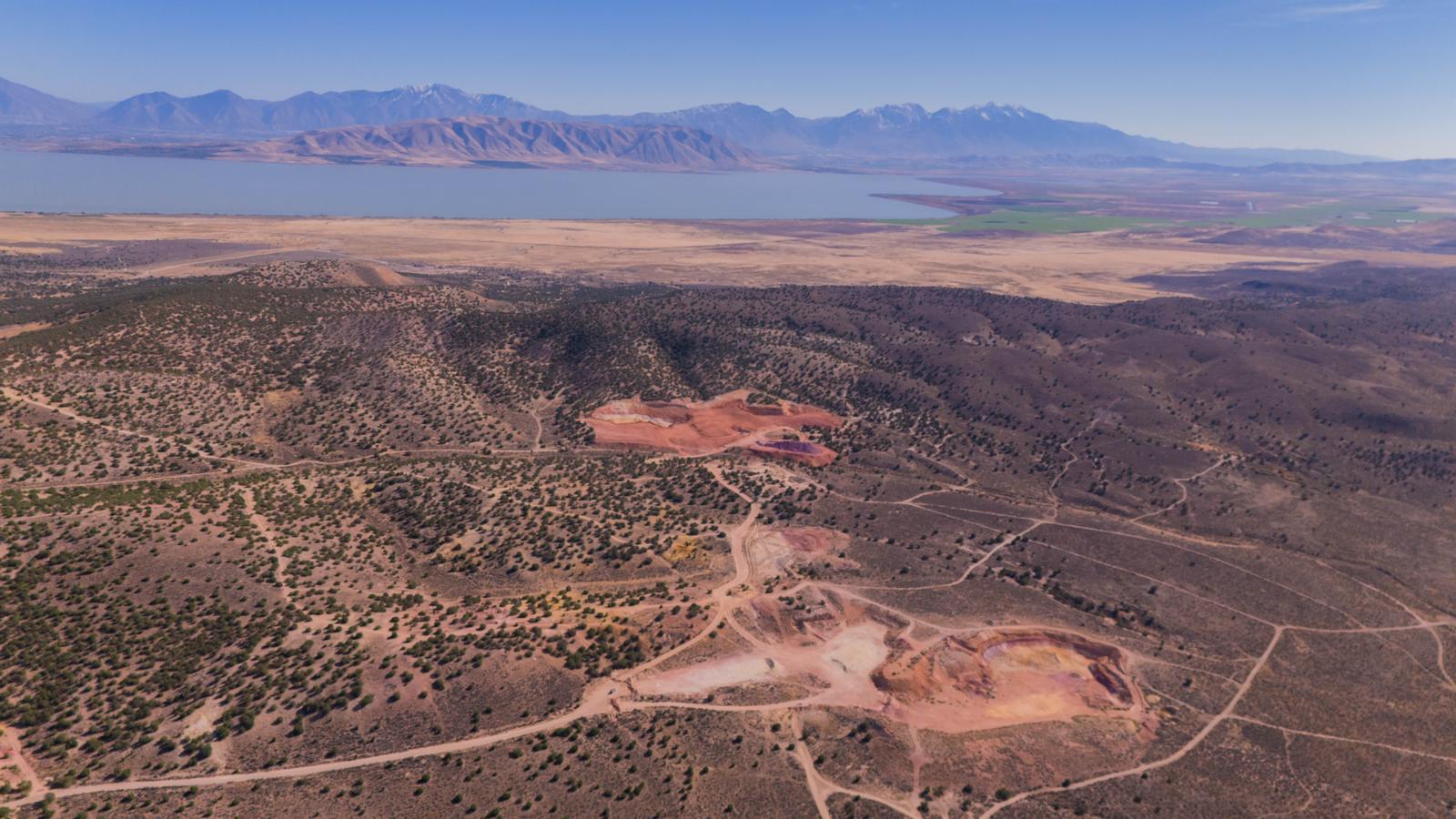
A Utah company says it has unearthed a massive deposit of minerals crucial for building electric vehicles, semiconductors, satellites, magnets, and more.
Ionic Minerals Technology, or Ionic MT, found its Silicon Ridge mine is chock-full of critical minerals and rare earth elements. According to Andre Zeitoun, Ionic MT’s CEO and founder, the newly discovered supply could support initiatives to electrify transportation and bolster defense, all while reducing dependence on foreign markets.
Secure · Tax deductible · Takes 45 Seconds
Secure · Tax deductible · Takes 45 Seconds
Silicon Ridge’s deposit of critical and rare earth minerals is suspended in clay, not hard rock, making it easier to extract. The clay holds 16 critical minerals, Zeitoun said, including gallium and germanium, used in electronics, fiber-optic cables, and lasers. The mine holds a large supply of halloysite, a mineral used to build better batteries. China by far produces the lion’s share of critical minerals, and when it recently restricted exports on them, U.S. companies were sent scrambling for new supplies.
“Over the last 20 years, [we’ve] kind of put ourselves in a situation,” Zeitoun said, “where we’ve allowed ourselves to be solely reliant on imports of these metals that power our lives.”
The discovery at Silicon Ridge could open the door to finding more rare earths throughout Utah, said Katie Potter, a professional geologist and professor of practice at Utah State University.
“It may kick off a halloysite gold rush,” Potter said.
Zeitoun said his company can extract the materials with virtually zero waste and that it will use no explosives or chemicals at the site. “We really view ourselves as kind of a next generation of mining,” he said, “and of responsible mining.”
The Silicon Ridge mine lies west of Utah Lake, the heart of Utah County, about an hour’s drive south of Salt Lake City. Ionic MT leases the site from the State Trust Lands Administration. The company also holds a permit with the Utah Division of Oil, Gas, and Mining, the terms of which remain confidential, state officials confirmed.
“We are excited about the ongoing progress on the project,” the agency’s director Mick Thomas said in a statement, “and the potential it represents.”
Rare earths are crucial for green technologies like wind turbines and solar panels, along with batteries and motors. Ionic MT launched in 2020 by mining halloysite from clay deposits in Juab County, near the town of Eureka. Halloysite is an aluminum-silicon mineral that electric vehicle manufacturers are tapping to help batteries charge faster and last longer.
“You can charge a vehicle as quickly as it takes to fill up a tank of gas,” Zeitoun said, “which is considered one of the key enablers of EV mass adoption.”
The company processes the mineral through a patented procedure at its 74,000 square-foot manufacturing plant in Provo. In search of more supplies, Ionic MT began exploring Silicon Ridge, but was surprised to find much more than halloysite.
“Our machine came back showing, in every single sample that we looked at, the same distribution of these metals,” Zeitoun said. “We first thought … maybe there’s a mistake.”
Third-party testing, however, revealed an abundance of metals, the CEO said. The Silicon Ridge deposit came from the same type of ancient volcanic formation that created rich deposits in China. That country currently produces around 60 percent of the planet’s supply of rare earths, and commands 90 percent of processing.
Similar deposits lie in Brazil and Australia, Zeitoun said, but Silicon Ridge is the only known analogue in the United States.
Utah’s halloysite formed from a volcanic flare up around 30 million years ago, Potter said. The ash settled near hot springs that created unique clays with tube structures.
“Those tubes can suck in rare earth elements and other critical metals, like lithium,” she said, “and prevent it from being leached or weathered away.”
Silicon Ridge’s proximity to roads, power lines, and a workforce make it favorable for mineral development as well, Potter said. “We also have climate change and a need to shift away from carbon-emitting energy resources,” she said. “If it’s not extracted here, where we have stronger environmental regulations … it’s going to be done by offloading those effects” to other countries.
Ionic MT initially leased 4,053 acres on Silicon Ridge from the Trust Lands Administration in 2023. They returned to that agency’s board in August seeking another 3,700 acres after more than 100 boreholes and trenches revealed ample rare earth and critical mineral concentrations in the clay.
The state will earn $13 per acre per year as part of the lease, and $1.60 per ton, or 10 percent of the gross value of the mined clay, whichever is greater, Trust Land documents show. All the revenue will go to Utah schools.
With state permits and a processing facility already in place, Zeitoun said his company is ready to move rapidly to begin harvesting the minerals. The mine could create hundreds of local jobs, he said.
The federal government has expressed interest in supporting the mine as well, according to Zeitoun, but he declined to disclose any details. The Trump administration has moved to secure more diverse supplies of rare earths in recent weeks after trade disputes with China.
State leaders, meanwhile, are having their own eureka moment over Ionic MT’s discovery. State Senate President Stuart Adams and House Speaker Mike Schultz, both Republicans, cited Silicon Ridge as a sign that Utah could be a powerhouse for clean energy. “Our state is uniquely positioned to lead the transition to cleaner energy,” Adams said in a news release Thursday, “by developing next-generation resources right in our own backyard.”
Governor Spencer Cox, also a Republican, called the new mine “a huge win for Utah and the nation” in a LinkedIn post. He added that the development will help fuel his “Operation Gigawatt,” an initiative to more than double the state’s energy production over the next decade.
Source link
Leia Larsen grist.org