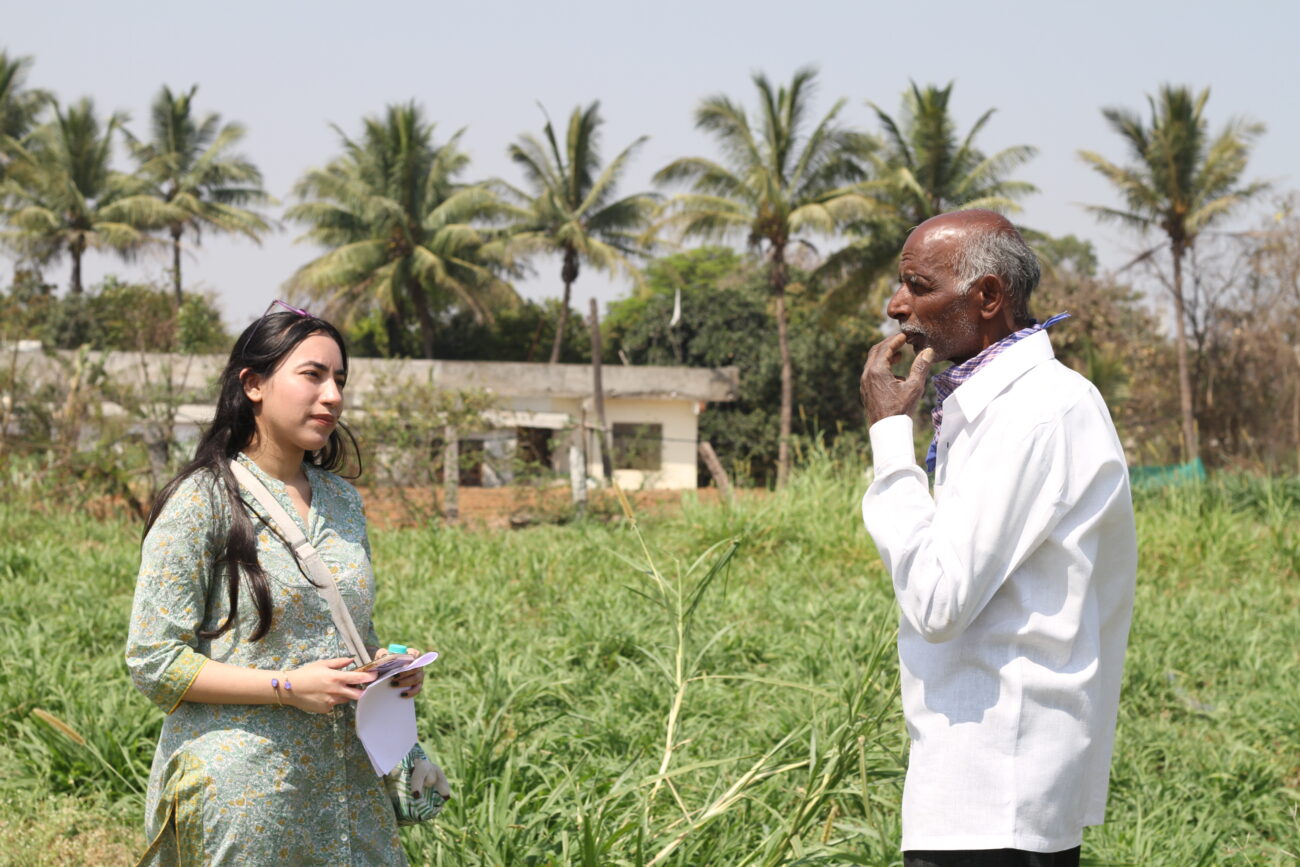
Over half of India’s population relies on agriculture for livelihood. Growing up in India, Stuti Banga wanted to be part of the work shaping her country.
Banga is now a second-year student in the M.P.A. in Development Practice program at Columbia’s School of International and Public Affairs. Prior to that, she worked on integrating technology into farming practices to increase yield and livelihood generation, both through Lenovo’s Work for Humankind Initiative and with the government of India.
After several years in hands-on roles, she came to Columbia and encountered a broader, systems-level way to think about change-making. She had witnessed how many of the challenges farmers face are intertwined, yet often treated as if they were separate problems. Stubble burning is one example. Though widely condemned as a major seasonal source of air pollution, it emerged in part from a policy response to water shortages, which required farmers to reduce their reliance on groundwater for wheat and rice.
“The ruling asked farmers to shift their sowing cycle ahead, but that moved sowing too close to the previous cycle. The shift didn’t leave enough time for farmers to clear out their stubble like they used to, so they started burning it instead,” Banga explained. And when you intervene in a complex system, efforts to fix one problem can create another: “A lot of people don’t know the history; all they see are farmers burning stubble and causing pollution. However, when you look at the whole system, you see that it was not always an issue in North India. It emerged as an unexpected consequence, trying to solve something else,” she said.
During her time at Columbia, Banga has adopted an interdisciplinary, layered and systems-level approach to change-making, to understand how one decision reverberates through an entire system. She came to Columbia with a background in sociology and psychology. While Banga originally felt anxious about her lack of data literacy, she knew it was needed to adopt an interdisciplinary framework.
“Getting comfortable with Python, getting comfortable with statistics, has been one of the biggest takeaways from my time here. Simultaneously, I have learned how agriculture is not just about agriculture, but it is also about health. It is about the environment, nutrition, politics and governance,” Banga said. “I realized there was this whole vocabulary being used, and organized ways of looking at a problem holistically.”
Bringing frameworks, and specific vocabulary across national and cultural boundaries, is not always an easy task. In fact, scaling a working system from one place to another is perhaps one of the biggest challenges climate solutions and mitigation work faces. To do this, Banga worked with Columbia Climate School’s Food for Humanity Initiative and GAIN (Global Alliance for Improved Nutrition), specifically on the Food Systems Dashboard (FSD).
FSD is the first platform to integrate national data across all components of the food system into a single, analytically guided interface. The platform enables policymakers and practitioners to set priorities, design interventions and track progress based on country-specific evidence. Under her faculty advisors Jessica Fanzo and Alison Rose at the Climate School and Rebecca McLaren at GAIN, Banga worked on adapting the dashboard for the subnational level in India, to speak more directly to national policy priorities.
“In much of the Indian development landscape, the term ‘food systems’ is not widely used, and is often collapsed into agriculture. The vocabulary of a problem is not the same everywhere. This is not a knowledge gap, but a communication one,” Banga said. “We are all trying to solve the same thing, but the terminology differs. How do you convey that? And if you can’t convey it, how do you get the buy-in from the government that you need?”
Banga found that the framework had to be “legible locally to enable coordinated action.” When making a global food system dashboard, she continued, “the data you are getting from each country reflects country-specific definitions, collection practices and institutional arrangements. It’s important to ensure local ownership within each government, because if you take responsibility as a global institution, there will be nuances you can’t understand. You need local buy-in and so listening to local stakeholders is the most important part of scaling anything.”
In her work, Banga consistently returns to questions of power and ownership. If she could redesign any part of the food system in India, it would be increasing community ownership and restructuring financing. Unbalanced power dynamics between financer and farmer can undermine commitment, and result in conflicting priorities working against each other.
“There is no such thing as a win-win. There is always someone who is not winning, and we have to work towards minimizing that as much as possible. We have to act and walk as one,” said Banga.
This is the responsibility Banga believes accompanies access to an education at Columbia. When you have access to these networks, these skillsets, these frameworks, there is a responsibility to use them for good, to uplift and to never be afraid to give credit—something she learned from her faculty advisor Glenn Denning, who teaches a core course on Universal Food Security. In other words, when the sun goes up, its light is for everyone.
“Make the best use of the resources you are getting and don’t keep them to yourself,” said Banga. “Share what you learn. We all get so competitive, but once you zoom out you realize that we are all working towards the same goal.”
Source link
Guest news.climate.columbia.edu