
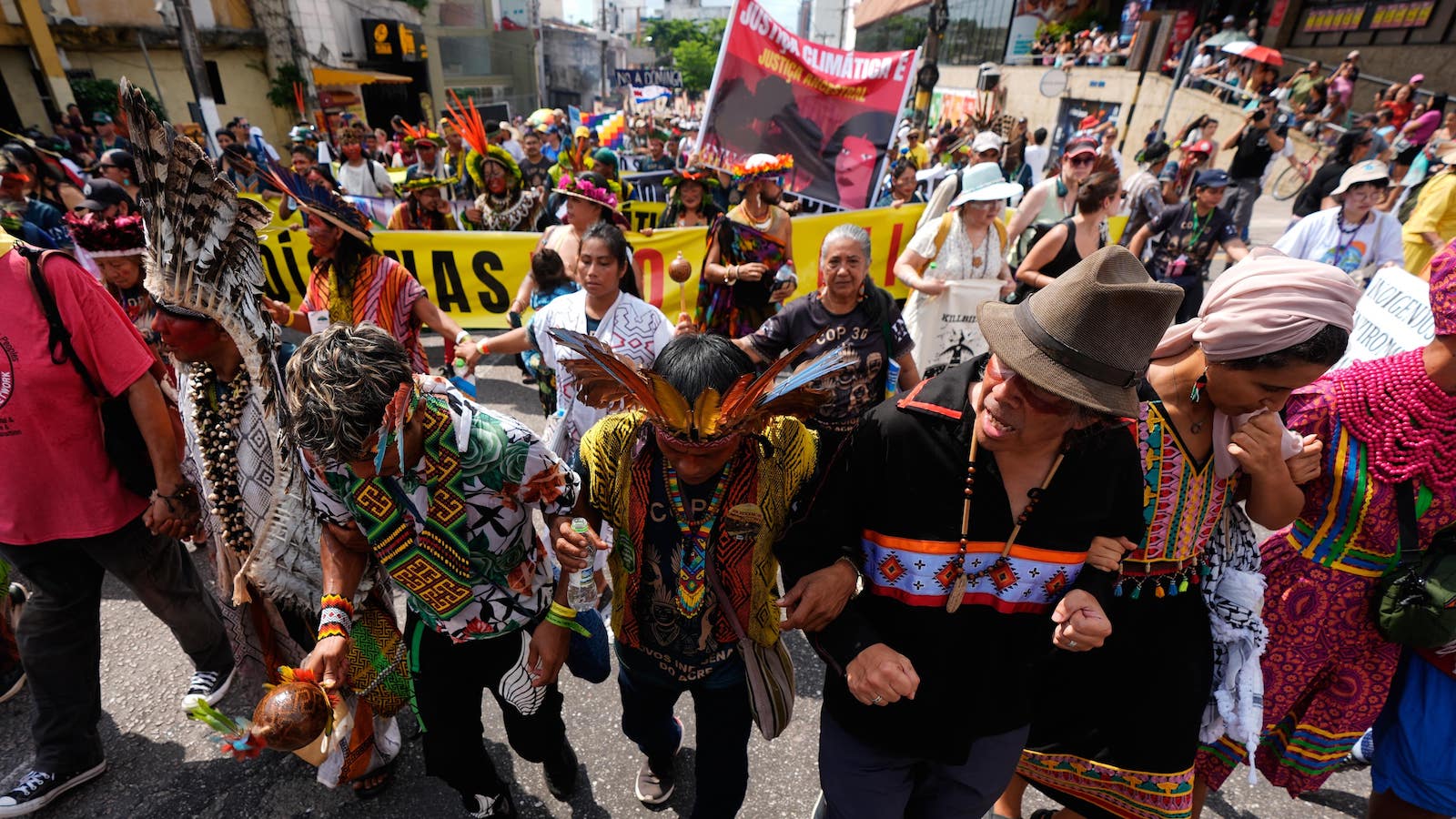
If there is one image that encapsulates COP30, this year’s global climate change conference in Belém, Brazil, it might be this: Indigenous activists, in traditional clothing and regalia, storming past security into a secure zone made for international negotiators and pre-approved delegates.
The action occurred on the second day of COP30 and underscored how this conference would be different from others. This COP had been billed as the “Indigenous COP,” given the venue’s proximity to the Amazon and Brazil’s efforts to ensure Indigenous participation. But that presence was still limited by the nature of U.N. negotiations, in which member states have voting rights and Indigenous peoples who haven’t achieved internationally recognized statehood are unable to vote on decisions such as when and how to transition away from fossil fuels.
Secure · Tax deductible · Takes 45 Seconds
Secure · Tax deductible · Takes 45 Seconds
Indigenous activists who didn’t receive official permission to enter the secure zones didn’t wait for permission. On multiple days throughout the conference, they marched in the streets, blocked the doors to the conference, pushed their way in, and made sure the world knew, “they can’t decide for us without us.”
To Kaeden Watts, a climate and Indigenous rights policy expert from the Māori tribes of Ngāti Tūwharetoa, Ngāti Maniapoto, and Tūhoe, who watched the conference unfold from Aotearoa New Zealand, it was a stark contrast to previous COPs he’s attended where Indigenous perspectives were often ignored or only heard when they were amplified by non-Indigenous allies like Greta Thunberg. This time, he saw news reporters interview Indigenous demonstrators and leaders who spoke about land rights and climate harms.
“This time you were seeing the amplification of Indigenous voices purely from an incredible organizing effort,” Watts said. “That’s an outcome we very rarely see and it’s resulted in tangible change.”
Before the end of COP, the government of Brazil took steps to demarcate the lands of 27 Indigenous peoples throughout Brazil, and promised to recognize 59 million additional hectares over the next five years.
According to the Articulation of Indigenous Peoples of Brazil, an organization representing Indigenous peoples in Brazil, more Indigenous participants were represented at this COP than in the entire 30-year history of the conference: More than 5,000 Indigenous participants, including about 900 with accredited access to areas where negotiators and pre-approved delegates met.
Indigenous advocates went into COP wanting nation-states to agree to a clear roadmap to transition away from fossil fuels and commitments to end deforestation. They had a slew of proposals they hoped to include in the Global Mutirão, a nonbinding international agreement among U.N. members at COP30, that would protect Indigenous rights and their territories. That didn’t happen, but countries did agree to formally recognize the importance of protecting Indigenous rights, including land rights, in the Just Transition Work Programme, a U.N. program to help countries transition off of fossil fuels.
That’s a big deal to Emil Gualinga, who is a member of the Kichwa People of Sarayaku and participated in COP30 as a member of the International Indigenous Peoples Forum on Climate Change, an official global caucus created to enable Indigenous peoples to engage in COP negotiations. Gualinga said that this year, Panama helped ensure the Just Transition Work Programme included a reference to Indigenous peoples’ right to free, prior and informed consent to what happens in their territories. This is increasingly important in light of studies that show mineral deposits critical to fossil-fuel free energy production are often found within Indigenous nations’ lands and waters.
But while he’s proud of that achievement, Gualinga was among many who were disappointed by the failure of U.N. member states to commit to a specific plan to stop relying upon fossil fuels, allowing the atmosphere to continue its path toward warming more than 1.5 degrees Celsius, which scientists have warned will wreak catastrophic consequences on Earth. The final version of the Global Mutirão was watered down by representatives from oil-rich countries like Saudi Arabia and countries with growing economies like China and India.
“None of our proposals were taken into account for the ‘Global Mutirão’ text,” Gualinga said, noting that ‘Mutirão’ is an Indigenous name. ”But even so none of the proposals were taken into account.”
Still, he isn’t discouraged. “The fight for Indigenous peoples is not only at the COP,” he added.
International venues like COP are important spaces for environmental justice advocacy on behalf of Indigenous peoples to both defend planetary health and their rights to land and water, but are just one tool among many. This is something Gualinga knows intimately; his community in the Amazon forest of southern Ecuador have spent decades fighting against oil industry efforts to drill on their lands. He was only a child when the oil industry entered their territory.
The Sarayaku people responded with organized resistance: The women snuck out in the middle of the night to steal weapons from the security forces and the village stopped fishing, hunting and going to school for six months in order to keep vigil over their land. The Sarayaku filed local and international lawsuits alleging that the oil company’s presence violated their right to free, prior and informed consent to what happens on their territories. In 2012, the Inter-American Court of Human Rights concluded that Ecuador had violated their rights by allowing the company to enter their territory.
“You don’t know in advance which strategies are going to work,” Gualinga reflected on the local advocacy. “I think it’s a matter of being creative and seeing where to focus.”
Earlier this year, Pacific island nations, led in part by Indigenous students and lawyers, won a landmark decision from the International Court of Justice that made clear that national governments have a legal obligation to mitigate climate change and compensate those harmed. Many who flew to Belem from the Pacific hoped the court’s ruling would provide needed pressure to compel global action, like transitioning off of fossil fuels.
Belyndar Rikimani, a Solomon Islander who attended the COP as a founding member of Pacific Islands Students Fighting Climate Change which initiated the ICJ case, was disappointed that the ruling wasn’t acknowledged. “At a moment when science is unequivocal and communities on the frontlines are sounding the alarm, the absence of any reference to a fossil fuel phase-out in the decision text is a devastating failure of political courage,” she said. “We will keep pushing inside courtrooms, negotiation halls, and at the grassroots until states meet their obligations and deliver the future our generation deserves.”
Gualinga said he expects to see Indigenous international advocacy continue next summer in Bonn, Germany, where another U.N. conference will discuss national and international guidelines for transitioning off fossil fuels, and at the First International Conference for the Phase-Out of Fossil Fuels in Santa Marta, Colombia, next April. “For the Indigenous movement in the Amazon Basin, this is an important event, given that Indigenous Peoples’ organizations have called for the Amazon, and especially Indigenous People’s territories, to be decreed as No Go Zones for extractive industries,” he said.
Kaeden Watts in Aotearoa New Zealand said that he thinks the visibility of Indigenous resistance at COP30 suggests that the messages of Indigenous peoples are starting to resonate with the public. He expects the movement for Indigenous climate justice to continue to grow, undeterred by the disappointments at COP.
“Ever since Indigenous peoples have had to fight for their rights — in whatever form that looked like — their advocacy and their determination for self-determination has never stopped,” he said. “And we’ll never see it stop.”
Source link
Anita Hofschneider grist.org
