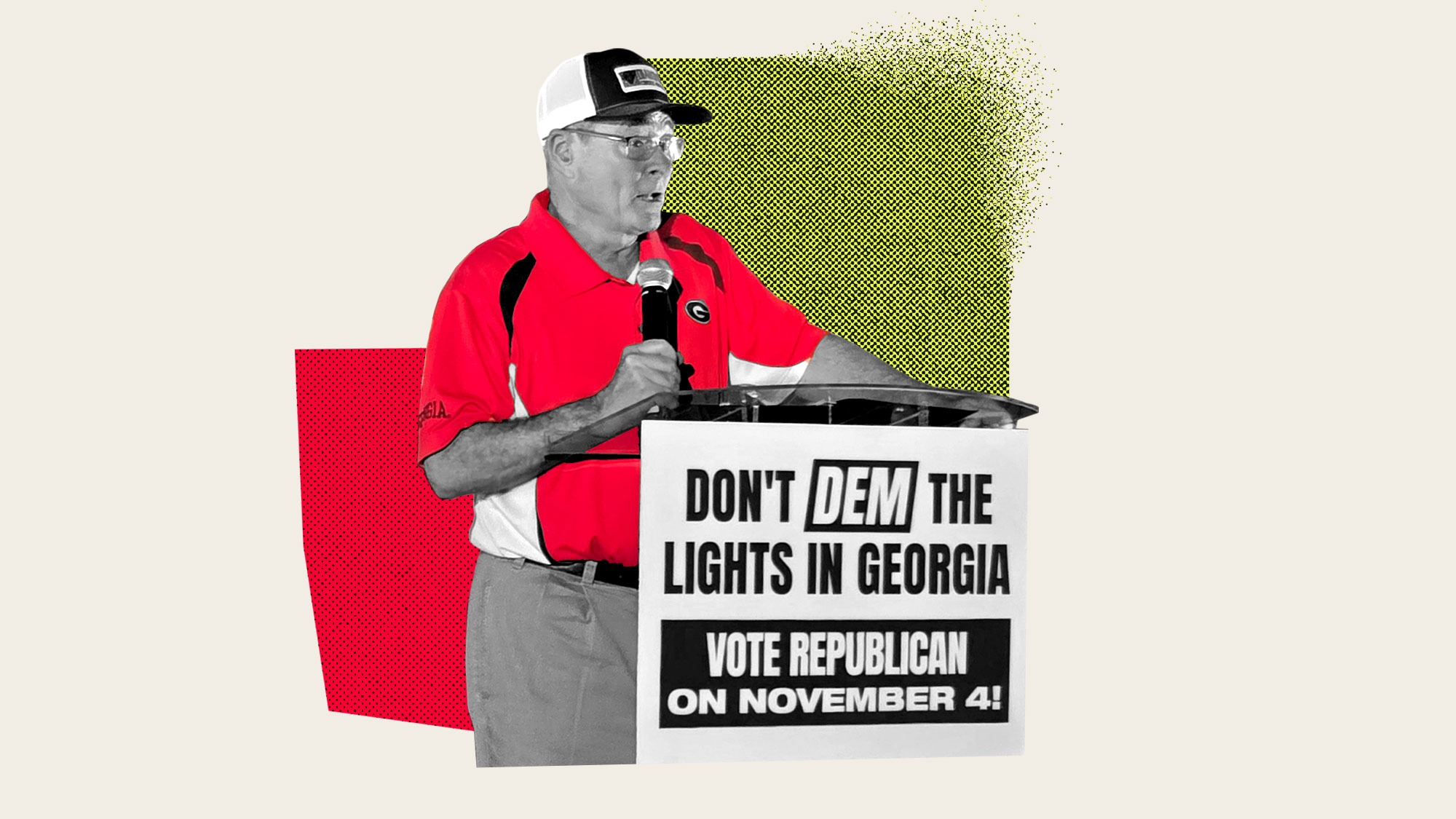
The Georgia Public Service Commission got a shock in November: After nearly two decades as an all-Republican body, two incumbent commissioners lost their seats. Georgia voters, frustrated by rising power bills, elected two Democrats with about 60 percent of the vote.
One of the ousted commissioners, Republican Tim Echols, was first elected to the PSC in 2010. In the world of energy regulation, Echols was a singular figure. Prior to joining the commission, he hosted a radio show called Energy Matters and conducted what he calls a “clean energy roadshow,” in which he showcased alternative-fuel vehicles and held panel discussions at events around the state. As a commissioner, he angered a student environmental group by telling them climate change wasn’t his lane, frustrated public commenters who often complained of feeling dismissed or unheard, and called fossil fuel plants “absolutely critical.” He also championed the new nuclear reactors at Plant Vogtle and pushed for more rooftop solar, electric vehicles, energy efficiency programs, and alternative fuels, which often put Echols at odds with his party.
During his final weeks on the commission, Echols sat down with Grist to discuss his legacy, Georgia’s energy future, and how he reconciles politics and faith. The conversation with Echols comes at a moment of transition for energy production in Georgia — there will once again be two seats on Georgia’s PSC on this year’s ballot. Fitz Johnson, the other commissioner who lost in November, is running for re-election this year; he didn’t respond to requests for an exit interview.
The following interview has been condensed and edited for clarity.
Q: Do you have advice or wisdom to share for either the new commissioners or your longtime colleagues?
A: I don’t have advice for my long-term colleagues. I’m not gonna give them any advice.
For Peter [Hubbard] and Alicia [Johnson] — they’re gonna need to find their own way. They’re gonna need to do what I did in the beginning. Go tour plants, meet with officials, meet with power company people, meet with the [Electric Membership Cooperatives]. I told Peter, ‘Hey, you know, start my radio show back, have guests come through, and just gain in knowledge.’ And then, if they will resist the temptation to only be a thorn in the side of the majority, they might could get some things done. They might could cooperate on some issues.
Q: Leading up to last year’s election, there was a lot of frustration within the general public. People felt that they were paying too much for electricity. Those members of the public who went so far as to bring their views to the PSC, as public commenters, felt frustrated that their voices weren’t being heard. How would you respond to them?
A: I mean, they’re wanting us to respond then and there with some love, and that’s not how it works. If all five commissioners responded to everybody who said something, we would be there all day. We’re there to listen to them, and their comment goes into the docket. But, you know, the comments that people have been making most recently about bills and about not using natural gas. Obviously, two commissioners lost their election, so they were somewhat effective. But in terms of trying to get Georgia not to build the power that we’re going to have to have for the future, there’s so many other things at play there.
And if you look at the majority of people that make comments at our commission are from DeKalb County. They’re either from Emory, or they’re from Decatur or DeKalb County. And it’s convenient for them to get there. Well, what would people in Macon actually say? Or what would people in Chatham County say?
I think sometimes we give too much credit to public commenters and think that they’re all pure as the driven snow — that they’re there because they care. Well, the fact of the matter is some of them were rounded up. Their speeches were written by other people. I mean, I’ve seen them. I’ve seen them handing out the speeches behind the scenes, and that’s OK, nothing wrong with that, but I give it the consideration that I feel that it deserves.
Q: Well, and to be fair, some of them seem to be a bit rounded up by Georgia Power, too.
A: I know. I’m sure Georgia Power tries to equalize things. But, you know, the public comment is a chance for people to say their piece. It’s not a time for commissioners to make a decision. We make a decision based on the data. There’s so much more than just people’s opinions that’s driving a decision.
Q: A lot has changed since you were first elected to the PSC — new technologies and a big increase in projected electricity demand. Can you share your thoughts and reflections on what some of the biggest changes have been?
A: When I got to the commission in 2011, we had virtually no solar. I mean, it was probably less than 20 acres of solar across the entire state, and these was rooftop of course. But in 2012, Bubba McDonald — who had been a Democrat legislator, had run for governor, and had been on the commission for some years — saw all the discussion I was having about solar in my clean energy roadshow, and he decided that now was the time to do something. And he crafted a plan to do what then was a massive amount of solar — 525 megawatts. And Doug Everett, his close friend, agreed to second the motion and support it, and Bubba needed one more vote. And so I became that vote, and it really launched solar. Georgia Power did not want to do it.
Q: So is that something the commission should be doing more of? Should the PSC be leading Georgia Power to better outcomes for the state, instead of following what the utility wants?
A: You know, honestly, we’re not engineers, none of us. We’re not as smart, in my opinion, as those professionals who are working at these utilities, and we are very dependent upon their knowledge of their own grid. So I think we can make sweeping policy changes just like we did with solar, but I don’t know that we need to be in there micromanaging all this little stuff that they’re doing.
What doesn’t get any credit is when we have a stipulation, meaning an agreement, between the power company and the commission. In the minds of people and my opponents, well, we just did what Georgia Power wanted. But really and truly, Georgia Power’s plan gets poked at. It gets sliced and diced and changed and modified.
I wanted to build five more nuclear reactors. If I could have gotten the commissioners to go with me on that, I would have motioned to build that instead of the gas plants. But, you know, the financial benefit for Georgia just wasn’t there, and I don’t know that the legislature would have supported us in that. I don’t know that the governor would have supported us in that. We would have been out there by ourselves.
I don’t regret supporting Vogtle, even if it did cost me the election. It was important. Moving towards solar, batteries, and nuclear is the way of the future. And I think we will eventually go that way. Those coal plants will close one day, and those gas plants will close, and what will remain will be nuclear energy and renewable energy in Georgia.
Q: Should the commissioners be considering emissions and the climate implications of their decision making more explicitly?
A: I think you’ll see that with Peter Hubbard, the new commissioner. I talked with him extensively recently. In fact, I offered for him to take over my radio show and my clean energy roadshow. He’s considering it. Peter knows a lot. So I do, I think you’ll see Peter trying to push the commission more in the environmental direction. I don’t know that he’ll have the votes, so I would anticipate a lot of 3 to 2 votes.
A lot of people want to turn us into the Georgia Environmental Protection Division, and we’re not that. We are financial regulators. We are there to make sure those utilities have the money they need to be able to operate and that ratepayers are getting a fair rate.
Q: A lot of folks do make the argument that giving consideration to climate and emissions falls under three main pillars of the PSC’s work — keeping energy production safe, affordable, and reliable. That it’s actually not safe to continue using resources that are spitting greenhouse gas emissions and worsening climate change. What is your take on that?
A: Climate change is a political issue, unfortunately, today. As an evangelical, I always talk about stewardship, and that God’s given us dominion over the planet — water, air, soil, everything that we have. So that’s how I approach it.
I know my left-leaning friends want me to go further. They want me to buy into Democratic talking points, and I just think it’s unrealistic to ask a person in one party to go way out here on the edge, regardless of whether it’s a Democrat or a Republican, and violate their party distinctives in order to do something. I just don’t think it’s a realistic thing. If the commissioners were appointed by the governor, that’s another thing, and you’re nonpartisan. As long as you are partisan, I think you’ve got to expect partisan politics to play into your thinking and your messaging.
Q: Then how do you balance where your party tends to stand on climate and environmental issues with your beliefs around dominion and stewardship?
A: Well, we’re taping this interview in my eighth electric car. I have solar on my home. Republicans have given me a hard time about these two things. And you might say that there was a dampening of enthusiasm for me from Republicans because of some of the positions that I’ve taken. So, I think, when you get out there off of the party platform like I have on EVs and solar, you do put yourself at risk. So how far do you go?
Source link
Emily Jones grist.org