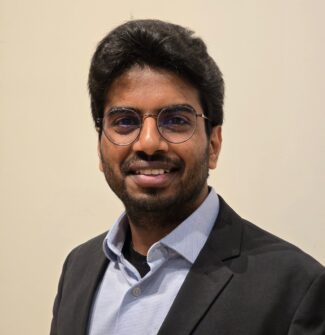
At COP30 in Belém, Brazil, the leaders of several countries launched an Open Coalition on Compliance Carbon Markets. The coalition stresses an international effort to establish carbon markets that operate at scale with credibility, through shared standards across borders. This emphasis mirrors the work of Shubham Deshmukh, who recently graduated from the M.S. in Sustainability Management program at the Columbia School of Professional Studies. Deshmukh determines how carbon markets can finance climate action, from project development in India to the policy questions that shape the markets globally.
Carbon markets are simultaneously promoted as an essential climate financing tool, and criticized as a license to pollute. A carbon market puts a price on greenhouse gas emissions via carbon credits that get bought and sold, almost like stocks. A credit represents one metric ton of CO2 that has been avoided or removed through a specific project. A project could target emissions through agricultural practices, CO2 capture or reforestation. Once a project has been measured and verified, the issued credits can be purchased by companies or governments to meet climate targets or compensate for emissions they cannot yet eliminate.
In a deepening climate crisis, where economies still rely on fossil fuels, the carbon market targets an uncomfortable question: What do we do with the emissions we can’t eliminate?
Deshmukh has spent the last several years working within this tension. He began his career as an electrical engineer and worked on rooftop solar in India, but his family connection to farming is what brought him to carbon markets. He realized that carbon markets could make a huge difference for farmers in India, and sees the market as a realistic financing mechanism for people who want to cut emissions but lack the financial means to do so. Deshmukh explained carbon markets to State of the Planet, using the example of a roadway.
“When roads are built, there are a lot of emissions, as the materials are fossil based. However, there are techniques through which you can reduce these emissions. But, in order for the contractor to follow those techniques, he would need to revamp all of his equipment,” Deshmukh said. “The government is not willing to pay that—they are just interested in getting a road built. This is where the carbon market comes in. If a contractor needs $1 million to reduce his operation emissions by transitioning to sustainable road pavements, he can sell the credits that have been made (from avoided emissions) and get his operation financed.”
Carbon markets try to bridge the gap between the world as it is: governments that want infrastructure quickly and industries that cannot decarbonize overnight, and the world we need: a world where emissions stop being treated as free. But the bridge only holds if it is engineered, which requires enforced standards, and the demand must be stable enough for projects to outlast political change.
Deshmukh argues that over the last two decades, the supply side has become increasingly rigorous: methodologies have been revised, verification strengthened and community treatment and revenue sharing has improved in response to criticism. The biggest challenge remains the demand. Without stable buyers financing remains uncertain. Additionally, there has been significant criticism of the market as an excuse for continued pollution, a system that rewards the wrong actors, and fails the communities it claims to benefit.
“I understand the concerns,” Deshmukh said, “but we can’t just wake up one day and say no more emissions. I don’t even think it will happen in our lifetime. There is still no way to replace cobalt, nickel and lithium, even though we know how these are being mined and the effect it has on communities, landscapes and ecosystems.”
Credits can become permission slips, but as Deshmukh also highlighted, for the industries we can’t decarbonize, we need other ways to reduce emissions. “Airlines are making a lot of profit and producing a lot of emissions, why not allow them to buy credits? Then you scrutinize the projects that airlines have invested in as much as you can, to ensure they are achieving what they are claiming. When you know you are being watched, you do good work on the ground; everything is at stake,” Deshmukh explained.
In a crisis that is reconfiguring our entire planet, can we afford to hit the delete button on any efforts? To Deshmukh, critique is not a reason to abandon carbon markets altogether. It is a reason to tighten standards and treat credits as a complement, rather than a substitute, for emission cuts.
This is also the reason Deshmukh chose to return to the classroom after six years of working professionally. Upon choosing Columbia, he shared that he was looking for a program that would offer him flexibility. “I wanted the ability to choose courses from different schools, and so Columbia’s M.S. in Sustainability Management worked really well for me.” At Columbia, he was able to shift his focus to governance. “I never delved into policies in my previous jobs; it was always execution on ground. I am very lucky to get that exposure now,” Deshmukh explained.
Columbia has also offered extensive research opportunities. Deshmukh has been the recipient of the Climate School’s Collaborative Research Grant for work on his project, “Investing in Regenerative Agriculture through Innovative Financial Instruments” with advisor Satyajit Bose, and the Climate School Travel Grant. Deshmukh is currently working on a separate project for the Center on Global Energy Policy. “We are conducting a comprehensive, country-by-country review of carbon credit market regulations across G20 countries and Singapore,” Deshmukh said.
“We are evaluating which jurisdictions are doing well, and identifying regulatory design choices, governance mechanisms and enforcement approaches that can be adapted by other countries,” he noted. “The goal is to have a practical, comparative policy guide, that any government official can use to understand what has worked elsewhere, what hasn’t, and what an effective, high-integrity framework could look like in their own context. The report is the first of its kind; I have never seen anything like it.”
Deshmukh now looks ahead at carbon markets in the U.S. The task will be to build strong systems, in which credits cannot substitute for decarbonization, but can finance measurable progress where progress is otherwise stalled.
Source link
Guest news.climate.columbia.edu