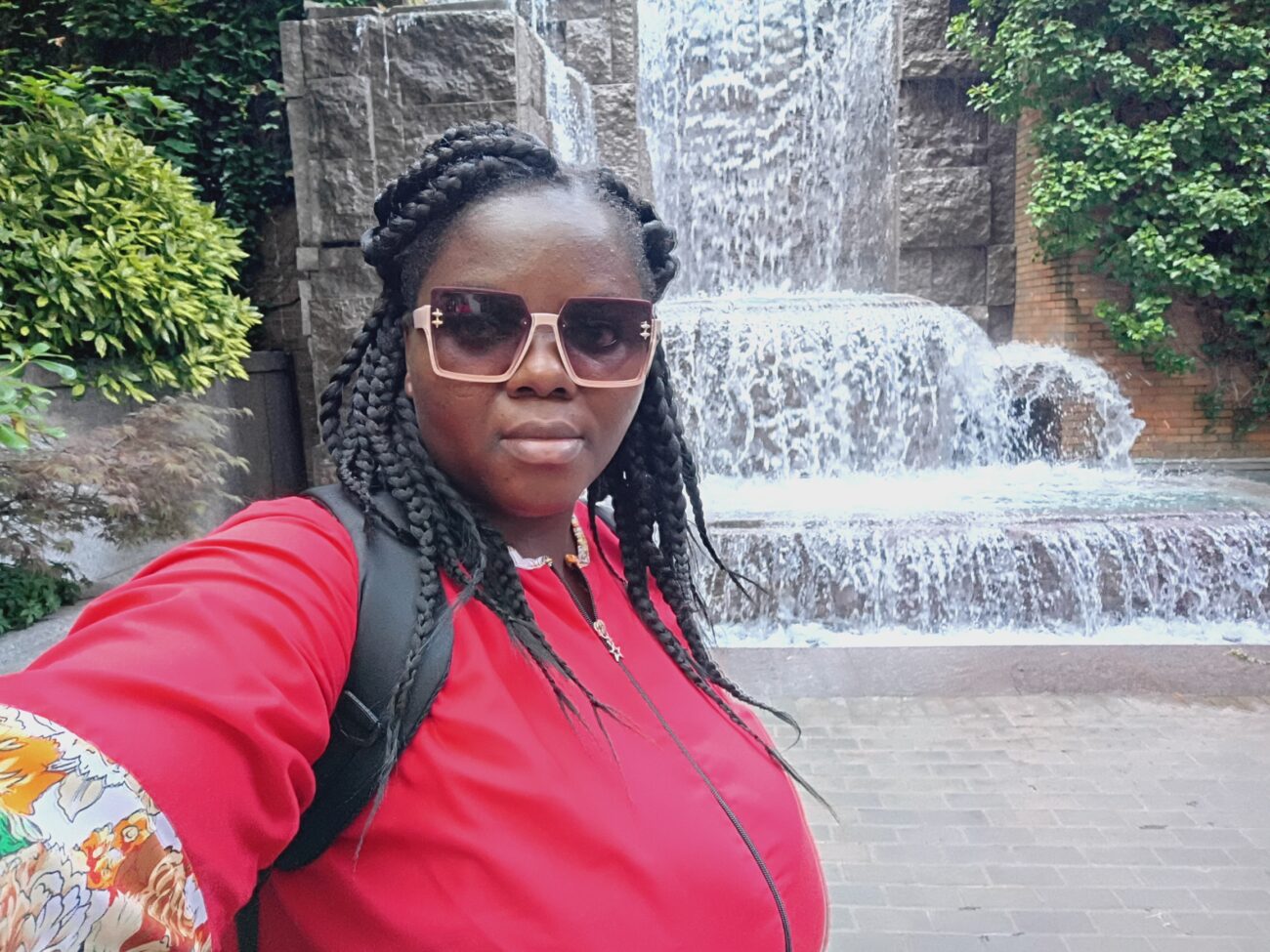
Since childhood, Das Dores Ngueussie Ngamini has been curious about the world around her and how it works. Ngamini has turned this curiosity into a career dedicated to scientific knowledge and climate justice, using the tools and information she gains to help communities most affected by climate hazards and often least equipped to face them.
Ngamini has master’s degrees in atmospheric sciences from the University of Yaoundé I in Cameroon, where she studied extreme weather forecasting, and in mathematical sciences from the African Institute for Mathematical Sciences in Rwanda, where she specialized in climate modeling. Before joining the National Center for Disaster Preparedness (NCDP) at the Columbia Climate School, Ngamini was a fellow in the small innovation grants program, a NASA- and USAID-supported initiative under the SERVIR West Africa program.
As a staff associate at the NCDP, Ngamini uses her background in atmospheric sciences and climate modeling to support research and solutions for climate adaptation and disaster preparedness. Read more about her career path and inspiration in the interview below.
How did you get into science?
I grew up fascinated by the natural world and the forces that shape our environment, but it wasn’t until university that I realized climate science could be a career and a tool for impact. I pursued master’s degrees in atmospheric sciences and mathematics because I wanted to understand climate systems deeply and use that knowledge to support communities facing the greatest risks. My path has always been driven by curiosity, responsibility, and the belief that science should serve people—especially those who are often left out of decision‑making.
Is there a woman in science, from Columbia or otherwise, who inspired you?
I’ve been inspired by many women who combine scientific rigor with a commitment to community. During my time working with SERVIR West Africa, I met women scientists who were leading climate adaptation efforts in environments with limited resources, yet they persisted with creativity and resilience. Their example showed me that scientific excellence is not only about publications or grants—it’s also about service, accessibility and lifting others as you climb.
“When we remove barriers, women thrive, and the entire field benefits.”
Have you faced challenges as a woman scientist? Do you see things improving?
Like many women, I’ve had moments where I had to work twice as hard to be taken seriously. Access to opportunities, funding and recognition can feel uneven. But I do see progress: more conversations about equity, more women in leadership, and more institutions acknowledging the structural barriers that exist. Change is slow, but it’s happening—and it’s happening because women keep pushing.
How can we continue to support and mentor women scientists?
Support has to be intentional. It means creating environments where women don’t have to justify their presence, where their expertise is recognized, and where mentorship is built into the culture rather than left to chance. It also means making science accessible—through training, funding, flexible pathways and tools adapted to different communities and languages. When we remove barriers, women thrive, and the entire field benefits.
Do you have any advice for younger women or girls who are interested in entering the field?
Follow your curiosity and trust your abilities. Seek mentors who value your potential, build a community that supports you, and give yourself permission to take up space. Science needs diverse perspectives, and every question you ask strengthens the field. Persistence, confidence and a willingness to learn will carry you far.
Source link
Olga Rukovets news.climate.columbia.edu