
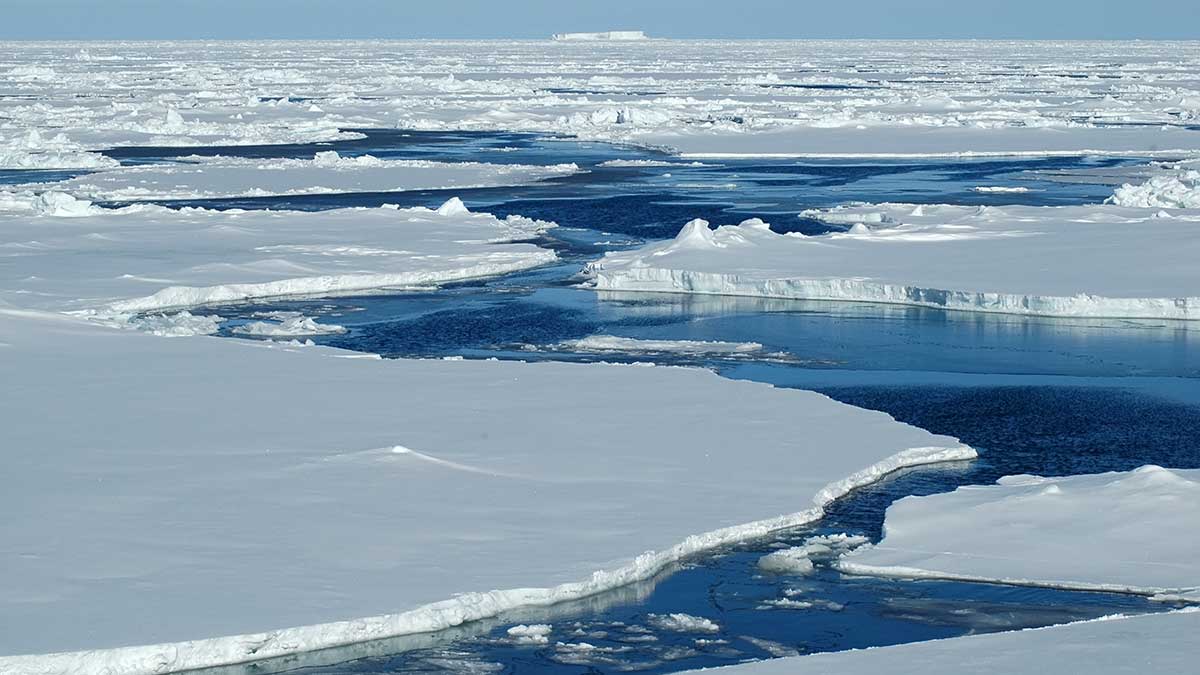
According to science, it was unexpected in 2008 when the famed Northwest Passage across the Arctic Ocean, which links the Atlantic to the Pacific, opened at the same time as the Northeast Passage. The Northeast Passage was expected to open first due to the Coriolis effect.
As the world turns to the east, in the Northern hemisphere, flowing water will veer to the right. Warm, salty Atlantic water flows into the Arctic Ocean through the Barents Sea Opening between Norway and Svalbard, and the Fram Strait between Svalbard and Greenland, then bends right along the Arctic coasts of Norway and Russia.
In the Greenland Sea, the Gulf Stream, barreling north with increasing volume, first surfaced in Svalbard, an archipelago on the threshold of the Arctic Ocean, in 2007. This caused land ice to melt. William Scorseby, a 21-year-old whaling captain, was surprised to find the Gulf Stream off Svalbard 100 fathoms deep in 1810. He reported that the Gulf Stream was strengthening with a greater percentage of annual rainfall flowing into the sea due to “the effects of human industry, in draining marshes and lakes, felling woods, and cultivating the earth” (see The Northern Whale-Fishery by William Scoresby, 1820, page 263).
The Arctic Circumpolar Boundary Current turns counterclockwise around the Arctic Ocean. Passing Scandinavia, increasing volume of warm Atlantic water slams into Russia’s Vamal Peninsula, warming the land, melting the permafrost, and likely contributing to an explosive pocket of methane creating a 164-foot crater.
Flowing throughout all seasons, the Siberian and Alaska coasts open nearly simultaneously when summer arrives. Further along the current, the northern coasts of Canada and Greenland have sea ice that remains attached to the shore, known as “fast ice.” Something other than warm Atlantic Ocean water opened the Northwest Passage.
Scientists are concerned about climate change because of rising carbon dioxide emissions and the decreasing coverage of white cumulus clouds, which trap more heat in the atmosphere rather than letting it escape into space. They were disappointed to find that atmospheric warming alone couldn’t fully explain the near-total melting of Arctic sea ice. With insufficient energy in the atmosphere, something was missing from their understanding of why the sea ice was melting so rapidly.
It was postulated that black Arctic Ocean water absorbed sunlight, converting its energy into heat, in addition to the heat already in the atmosphere. The measurement of how much sunlight a surface reflects versus absorbs is called the albedo effect. Dark surfaces, like a black car seat, have a low albedo and absorb more heat than does a white car seat.
This effect can be investigated empirically by placing a pint glass of black coffee and a pint glass of white milk on a sunny table, recording temperatures over time. The coffee’s temperature will not increase above the milk or the air temperature because water molecules are free to move as the density changes with heat. The motion of water molecules in a cooling cup of coffee has been described as chaotic. The temperature of any part of the liquid cannot be predicted.
Mariners know that when the sun is intense in the sky, the sea’s face is no less bright, there is no black water to rest their eyes on.
Open Arctic seawater was responsible for the heat measured in the atmosphere above it. Water is roughly 800 times denser than air and has an elephantine capacity to store heat. That’s why we wait for hot coffee and tea to cool enough to drink, yet a 120-degree sauna bath does not scald. It is also why we like to live by the sea, where the ocean cools the summer and warms the winter. Something other than a warming atmosphere opened the Northwest Passage.
Canada’s north coast, where the sea ice remains fast in summer, is the world’s largest mass of exposed Precambrian rock known as the Canadian Shield. Acasta gneiss, a metamorphic rock, is over 4 billion years old. Igneous granites, characteristic of Archean continental crust, expose the heart of the North American continent. On the rugged, rocky terrain of the Canadian Arctic Archipelago, the Albedo is low and the land warms during the summer. Ice in the channels that thread through the bear landscape melts and retreats from the shore’s touch.
When Canada’s rocky islands warmed, the Northwest Passage opened, and the heat in the atmosphere rose. Clearer skies with fewer white cumulus clouds, which reflect energy into space, expedited the solar warming of Canada’s rocky landscape, opening the Northwest Passage.
Science is a cyclical process of observing, questioning, recording, and communicating. Scoresby discovered the Gulf Stream coursing north through the Greenland Sea, using a ten-gallon fir cask designed by Joseph Banks, made of the softwood that conducts the least heat.
Science has become hands-off deferential to the authority of the three publications where one must publish to receive government funding. Often, this is narrative-driven science where the findings of researchers are obscured and generalized in the abstract and title, the only portion of articles that is publicly accessible. The publisher claims no responsibility for any supporting information supplied by the authors.
For example, we are told the Gulf Stream is slowing. Researchers report a decrease of about 2 Sverdrups (2 million cubic meters of water per second). This is not alarming because the Gulf Stream flows at 150 Sv with a seasonal variation of 1 to 3 Sv. It is fastest in the summer when freshwater from land increases the density difference.
We are told that melting the Greenland ice sheet is raising the ocean. Yet, Greenlanders living along the coast have seen no increase in water flowing to the sea, except in 2012 when a bridge was damaged. Most of the meltwater observed on top of the ice sheet refreezes in October.
We are responsible for the increase in greenhouse gases. Carbon dioxide at 427 ppm accounts for 3,341 gigatons of GHG, with molecules of carbon remaining in the atmosphere for a thousand years. Water vapor accounts for about 12,900 gigatons of GHG, with each molecule lingering for an average of 9 days.
To paraphrase Tracy Chapman, finally, the tables are starting to turn. We’re talkin’ ’bout an Earth Rehydration Revolution with less heat energy in the atmosphere and more water in the land.
About the Author
Dr. Rob Moir is a nationally recognized and award-winning environmentalist. He is the president and executive director of the Ocean River Institute, a nonprofit based in Cambridge, MA, that provides expertise, services, resources, and information not readily available locally to support the efforts of environmental organizations. Please visit www.oceanriver.org for more information.
Source link
Guest Contributor earth911.com
