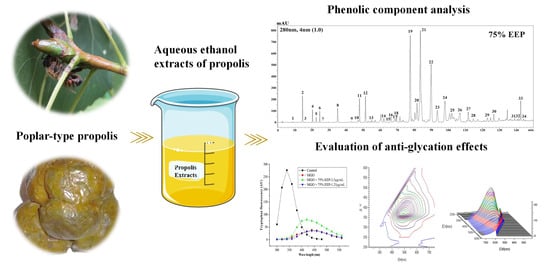
Propolis contains abundant phenolic compounds, which confer upon it a wide range of functional activities, such as antioxidant, anti-inflammatory, antimicrobial, antifungal, and anti-diabetic properties. Consequently, the identification of phenolic compounds in propolis is crucial for the comprehensive exploration of its potential properties. In this investigation, the phenolic composition of aqueous ethanol extracts of poplar-type propolis was analyzed utilizing HPLC-PDA. Figure 1 displays the HPLC chromatograms of propolis extracts obtained using different ethanol/water solvents, revealing notable variations. These chromatograms can be categorized into two distinct types. The first type, comprising WEP (Figure 1B) and 25% EEP (Figure 1C), exhibited a limited number of peaks mainly occurring prior to a retention time of 50 min. The second type encompasses 50% EEP (Figure 1D), 75% EEP (Figure 1A), 95% EEP (Figure 1E), and 100% EEP (Figure 1F), which exhibit a greater abundance of peaks within the retention time range of 50 to 140 min. The findings imply that ethanol concentrations of 50% or higher appear to facilitate the extraction of a broader range of components present in propolis, including flavonoids, phenolic acids, and their esters; in contrast, only phenolic acids present in WEP and 25% EEP, such as caffeic acid, p-coumaric acid, ferulic acid, isoferulic acid, and 3,4-dimethoxy cinnamic acid. The extraction efficiency of 75 wt.% ethanol/water was found to be the highest, as evidenced by the presence of the highest number of compound species and contents (Figure 1A). Specifically, 34 compounds, comprising 19 phenolic acids and their esters, 13 flavonoids, and 2 unsaturated hydrocarbons, were identified in the 75% EEP (Figure 1 and Table 1). Flavonoids were observed to be the predominant components in the 75% EEP, especially with pinobanksin-3-acetate, pinocembrin, chrysin, galangin, 5-methoxy pinobanksin, and pinobanksin. Among these, pinobanksin-3-O-acetate exhibited the highest content of 196.91 mg/g. The sum of the quantified 13 flavonoids exceeded 50% of the total weight. Previous literature has reported that flavonoid compounds such as chrysin, galangin, pinocembrin, pinobanksin and its ester derivatives exhibit strong antioxidant activities and are associated with reduced risk of various diseases, including heart disease, asthma, cancer, diabetes, and Alzheimer’s [25]. For instance, pinobanksin-3-cinnamate may provide neuroprotection through counteracting oxidative stress and has the potential to treat vascular dementia [26]. Pinocembrin has been shown to inhibit atherosclerosis progression by enhancing the level and function of endothelial progenitor cells [27]. Our previous research demonstrated that galangin and pinocembrin from propolis can improve insulin resistance in HepG2 cells [28]. Additionally, some flavonoids, such as quercetin and genistein, have been confirmed to inhibit AGEs [29]. Therefore, we speculated that the high content of flavonoids in the poplar-type propolis, including pinocembrin, chrysin, galangin and pinobanksin and its ester derivatives, etc., may be the primary trigger for its inhibitory effects against protein glycation.
Source link
Guangxin Wang www.mdpi.com