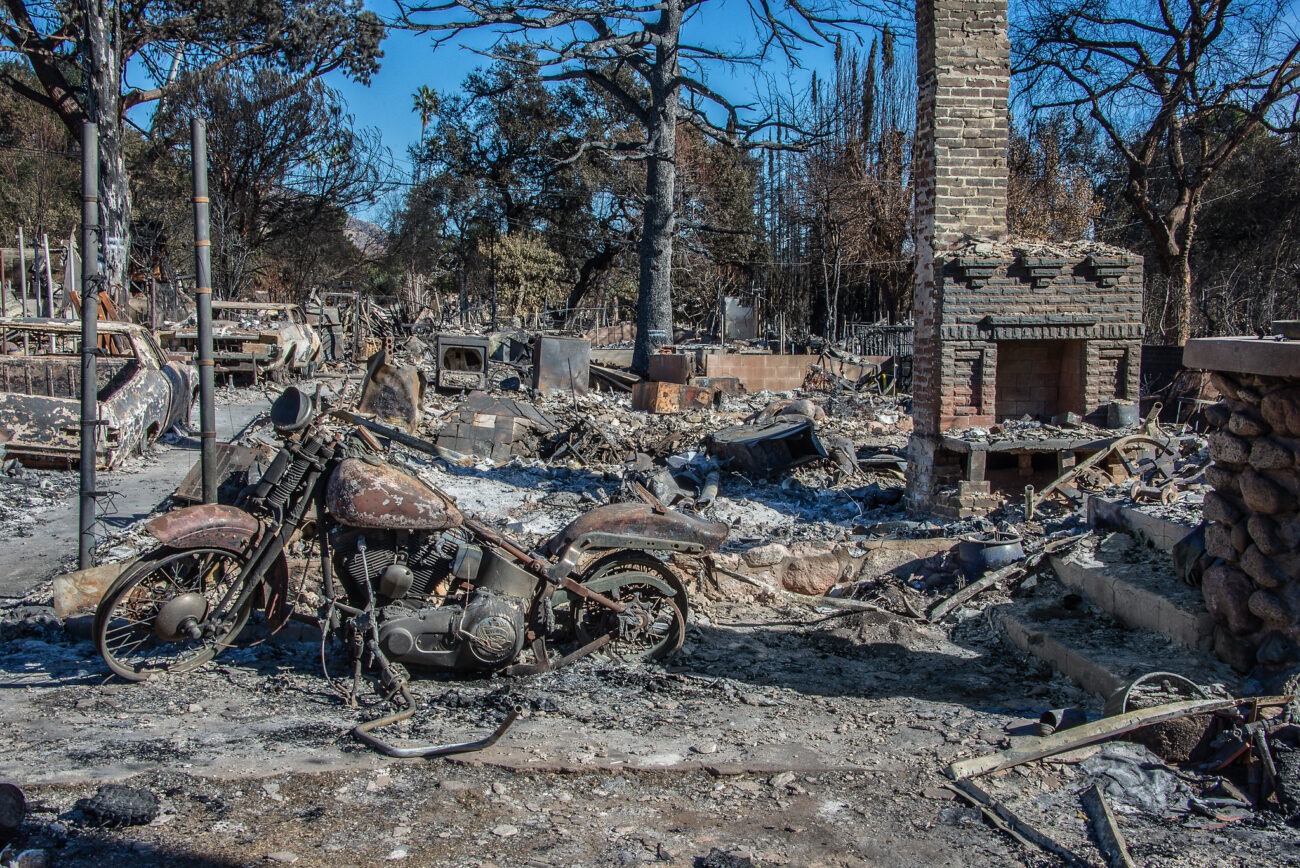
The wildfires that ravaged Los Angeles a year ago were among the worst in California’s history. They were exacerbated by persistent drought, a buildup of vegetation and Santa Ana winds which, at times, exceeded 80 mph. The most damaging fires, which reduced Altadena and Pacific Palisades to ashes, were finally extinguished on January 31, 2025.
A year later, what have we learned about the wildfires and their aftermath?
Approximately 59 square miles burned. An estimated 440 people died—31 as a result of direct contact with the fires; others as a result of heart and lung conditions aggravated by the smoke and stress, or breakdowns in the health care and mental health care systems. More than 200,000 people were forced from their homes and as of October, about 70% of residents remained displaced.
Over 17,000 homes were destroyed, seriously damaged or rendered uninhabitable. The tons of ash and debris left behind were laden with toxic material because many homes were built before 1975 and constructed with lead paint and toxic asbestos, both of which are now banned by the Environmental Protection Agency (EPA). Hazardous material, like asbestos, batteries and propane tanks, was initially removed by the EPA , and by September, the U.S. Army Corps of Engineers had cleared 2.6 million tons of ash, debris and contaminated soil from the area.
While drinking water and outdoor air quality have returned to normal and stabilized, some volatile organic compounds remain in smoke-damaged homes. And some houses that survived and have been cleaned still show levels of lead and asbestos that exceed EPA safety levels.
Although many people vowed to rebuild their communities, less than 12 homes have been rebuilt in L.A. County so far, mainly by wealthy property owners. The majority of residents have not applied to rebuild. In the area of the Eaton Canyon fire, which devastated Altadena, 511 homes are being built, and in the Palisades, 370. Many people cannot afford to rebuild because they were uninsured, under insured, or received payouts that were simply insufficient to rebuild. Some who cannot rebuild are trying to recoup the investment in their homes by selling to real estate investors or corporations. But because there are so many lots for sale, property values are falling. Analysts calculate that the fires resulted in a loss of $8.3 billion in home values across Altadena and the Palisades.
“Rebuilding is chronically slow in the areas affected by the fires, with only a small fraction of the homes destroyed under construction a year later,” said Jeff Schlegelmilch, director of the National Center for Disaster Preparedness at Columbia Climate School. “This leaves communities in limbo while the world moves on.”
“The history of disasters generally takes us down a path of loss until we reach a breaking point…and then transformative innovation follows.”
It is unlikely these communities will receive additional federal funds for rebuilding as we have seen in past disasters, he added, and organizations like the Federal Emergency Management Agency and associated funding for disaster prevention and recovery continue to exist in “a state of persistent uncertainty.”
“The insurance industry also continues to reel from this and other disasters without a clear pathway towards solvency, and the political complexities at all levels of government makes for a process that is loud, toxic and perpetually unable to get out of its way,” said Schlegelmilch.
L.A. will be better off in some ways after rebuilding, he noted. “California has some of the most robust fire codes [Zone Zero] for areas exposed to wildfire hazards, and many of these have been expanded in the wake of the wildfires,” Schlegelmilch said. Meeting the current standards will help ensure resilience in the face of future hazards, but it will not eliminate the vulnerability completely, he said.
Schlegelmilch believes we “have the lessons we need to do better and recover better, but there is a stubbornness to learning and applying them.” For example, the NY Times reported that homeowners in Brentwood, an upscale west LA neighborhood that almost burned last year, are fighting back against new home-hardening rules requiring them to cut back vegetation around their properties because they don’t want to lose their trees. And the local officials are reluctant to challenge their constituent-homeowners.
Protecting neighborhoods from fire will require everyone’s collaboration. “Community-based organizations and nonprofits are doing what they can, but the task is monumental and requires a whole-of-society approach,” said Schlegelmilch. “The history of disasters generally takes us down a path of loss until we reach a breaking point and decide what we are doing is no longer working, and then transformative innovation follows.”
“Whether the LA wildfires will be that breaking point or whether we have further to go remains to be seen,” according to Schlegelmilch. “But it speaks to the importance of our work at the Columbia Climate School, and our interdisciplinary approach to preparing the next generation of leaders to tackle these challenges, and to carry forward the transformations in climate adaptation that we need now more than ever.”
Source link
Renée Cho news.climate.columbia.edu