
What if disruptions to Tribal Nations’ households, livestock and lands, from flooding, wildfires, drought, severe storms and other extreme weather events, could be reduced through more effective risk communication? Rather than relying solely on one-way alerts, what if disaster communication systems were designed to better reflect Tribal priorities, knowledge systems and lived realities?
These questions framed the conversation at this year’s inaugural seminar from the Columbia Climate School’s National Center for Disaster Preparedness (NCDP). The event brought together Thomas Chandler, managing director and research scientist for NCDP; Daniel Osgood, NCDP senior research scientist; Marty Antone, former director of emergency management and homeland security for the Oneida Nation of Wisconsin; and Dion Tapahe, a graduate student researcher at the NCDP and member of the Diné/Navajo Nation, to discuss a new, collaborative project aimed at elevating and bridging Tribal voices in disaster risk communication.
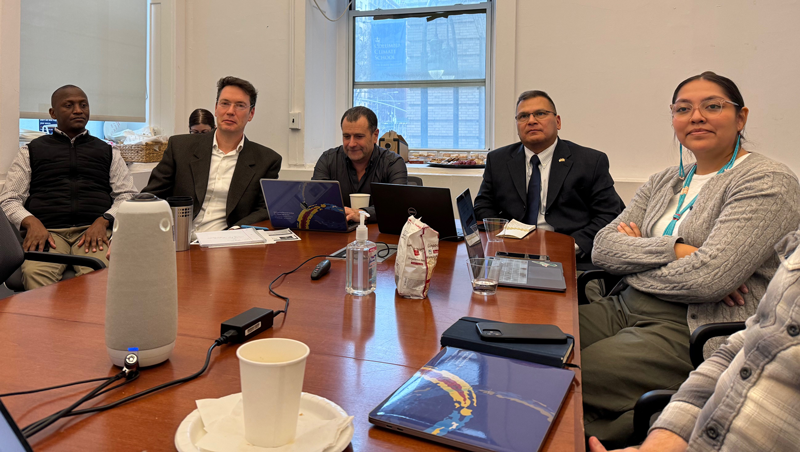
During the seminar, Thomas Chandler introduced a grant funded by Twilio.org that will support the development of innovative, culturally grounded disaster communication strategies in partnership with Tribal Nations across the United States. The project seeks to move beyond conventional emergency alerts by creating communication systems that are multi-directional, community-informed and actionable.
At the core of this effort is a partnership-based approach. NCDP will work directly with Tribal leaders, emergency managers and community organizations to co-design and implement new communication systems built on Twilio-based platforms. These systems are intended not only to disseminate information but also to enable dialogue, allowing community members to share needs, ask questions and participate in decision-making during emergencies.
“This project is exciting in that we are striving to develop cutting-edge, culturally grounded tools that communities can share, receive, and act on life-saving information during emergencies,” Chandler said.
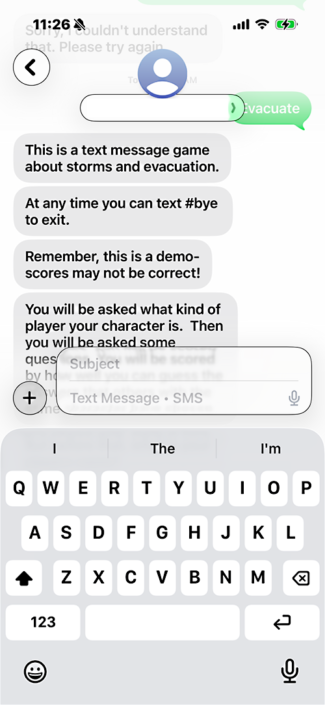
A central feature of the project is the development of two-way, text-and-voice-based disaster communication tools. These tools will enable residents to engage in scenario-based decision-making in a safe, accessible format, allowing them to practice responding before a real emergency unfolds. Osgood, the project’s principal investigator, emphasized that this work builds on years of interdisciplinary collaboration. “This effort is the culmination of years of work with NASA, the National Science Foundation and the United Nations,” he explained, “and it has the potential to be transformative in giving people a real voice in how we collectively respond to disasters.”
Seminar participants had the opportunity to test early versions of a text-based decision-making game and provide feedback on its design and usability. As the project advances, these tools are expected to evolve into trusted communication systems that support transparency and accountability—shifting from one-way warnings to two-way engagement that enables residents to report needs, receive tailored guidance and collaborate with local authorities in real time.
For Tapahe, it’s essential that the tool be grounded in cultural values and real relationships. As Tapahe explained, many families live in multi-generational homes, where connections extend beyond the household to the community, livestock and the land itself. Honoring these relationships will be central to how the tool is designed and used. Tapahe also emphasized the need for long-term commitment: Too often, well-intentioned organizations arrive with solutions and then move on. Building trust means investing in lasting partnerships—with this project, with NCDP and with Twilio.org. Protecting Tribal data and ensuring Tribal ownership of information, she added, will be critical to making this work sustainable over time.
Beyond tool development, the project includes a strong capacity-building component. NCDP will create training programs and co-design workshops to address urgent gaps in Tribal risk communication. By embedding technical innovation within Tribal community-driven design processes, the project aims to support sustainable, locally governed communication systems that strengthen preparedness, improve response coordination and enhance resilience over the long term.
Together, this initiative reflects a growing recognition that effective disaster risk communication is not just about technology—it is about trust, voice and partnership.
Source link
Guest news.climate.columbia.edu
