
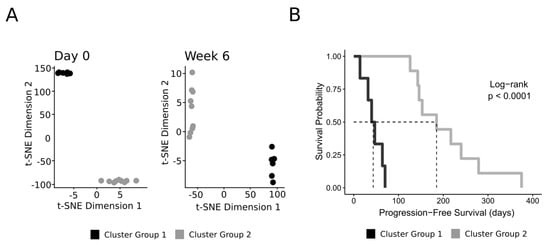
We compared the gene expression profiles between the two cluster groups at the initial timepoint and at the six-week timepoint. At the initial timepoint, we found 7721 significantly differentially expressed genes (FDR-adjusted p-value < 0.05), 4095 up-regulated, and 3626 down-regulated (Figure 2A,B; Table S1). At the six-week timepoint, we found 7416 significantly differentially expressed genes (FDR-adjusted p-value < 0.05), 4077 up-regulated, and 3339 down-regulated (Figure 2A,B; Table S2). Of the significantly differentially expressed genes, 3874 up-regulated genes and 3236 down-regulated genes were significant at both timepoints, which accounts for about 85% of the genes tested (Figure 2B). No genes were significantly differentially expressed at both timepoints with opposite fold changes. We identified significantly enriched GO terms (FDR-adjusted p-value < 0.05) separately in the up- and down-regulated, significantly differentially expressed genes at both timepoints. In the genes up-regulated at both timepoints, we identified 265 GO:BP, 59 GO:CC, and 23 GO:MF significantly enriched terms, and 112 significantly enriched TRANSFAC transcription factor motif terms (Figure 2C; Table S3). The enriched GO:BP terms included terms related to signaling, response to chemical stimulus, secretion, transport, metabolic process, vascular development, cell adhesion, and phosphorylation (Figure 3A). In the genes down-regulated at both timepoints, we identified 740 GO:BP, 223 GO:CC, and 156 GO:MF significantly enriched terms, and 1091 significantly enriched TRANSFAC transcription factor motif terms (Figure 2C; Table S4). The enriched GO:BP terms in the down-regulated genes included terms related to lymphocyte activation, immune response, proteolysis, autophagy, regulation of RNA stability, DNA repair, chromosome separation, and cell cycle checkpoint (Figure 3A).
Several important genes and pathways were significantly differentially expressed (FDR-adjusted p-value < 0.05) in the cluster group with shorter PFS compared to the cluster group with longer PFS (Figure 3B). The p53 regulators MDM4 and MDM2 were up-regulated and down-regulated, respectively. Cell cycle regulators CDKN1A and RB1 were up-regulated and down-regulated, respectively. Ras/Raf/MEK/ERK pathway genes NRAS, BRAF, ARAF, and MAPK2 were up-regulated but MAPK1 was down-regulated. PI3K/AKT/MTOR pathway genes PIK3CA, PTEN, AKT2, and MTOR were down-regulated. AKT target genes TSC1, BAD, FOXO1, and CDKN1A were up-regulated and HIF1A, GSK3B, FOXO1, and MDM2 were down-regulated. TGF-β pathway genes TGFBR2, SMAD2, SMAD3, and SMAD4 were down-regulated. NF-κB pathway genes NFKB2, RELA, and RELB were up-regulated and NFKB1, IKBKB, and NFKBIA were down-regulated. MYC transcription factor was up-regulated. The chromatin organization gene CTCF was down-regulated. The multi-drug resistance gene ABCB1 was down-regulated. Since only about 10% of the genes tested, 829 genes, were not significantly differentially expressed between the two cluster groups at both timepoints, these genes may be of interest as well in that their level of expression may be necessary for cellular function of both molecularly distinct subtypes. Biologically important genes with no significant difference in expression between the two groups included TP53, CDK6, AKT1, APC, LEF1, and TERT.
Source link
Miles W. Mee www.mdpi.com
