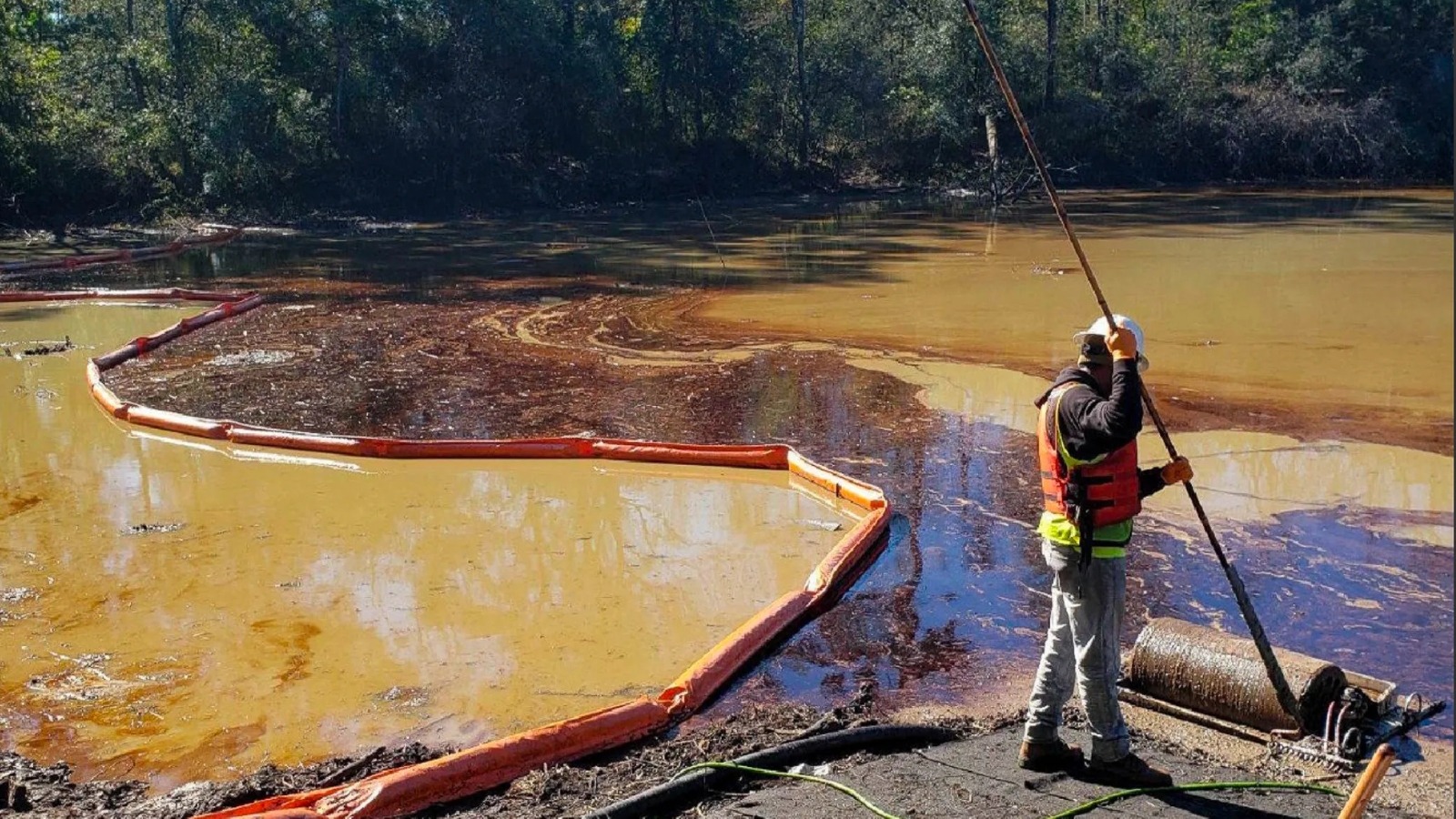
Four months have passed since a Louisiana oil facility burst apart, spewing a dense black sludge that drifted across homes, farms, and waterways as far as 50 miles away.
Since then, the U.S. Department of Justice and Louisiana environmental regulators have filed a sweeping lawsuit against Smitty’s Supply, the company that ran the facility storing oil and vehicle lubricants. But residents in the majority-Black town are skeptical that they’ll benefit from the $1 billion federal lawsuit.
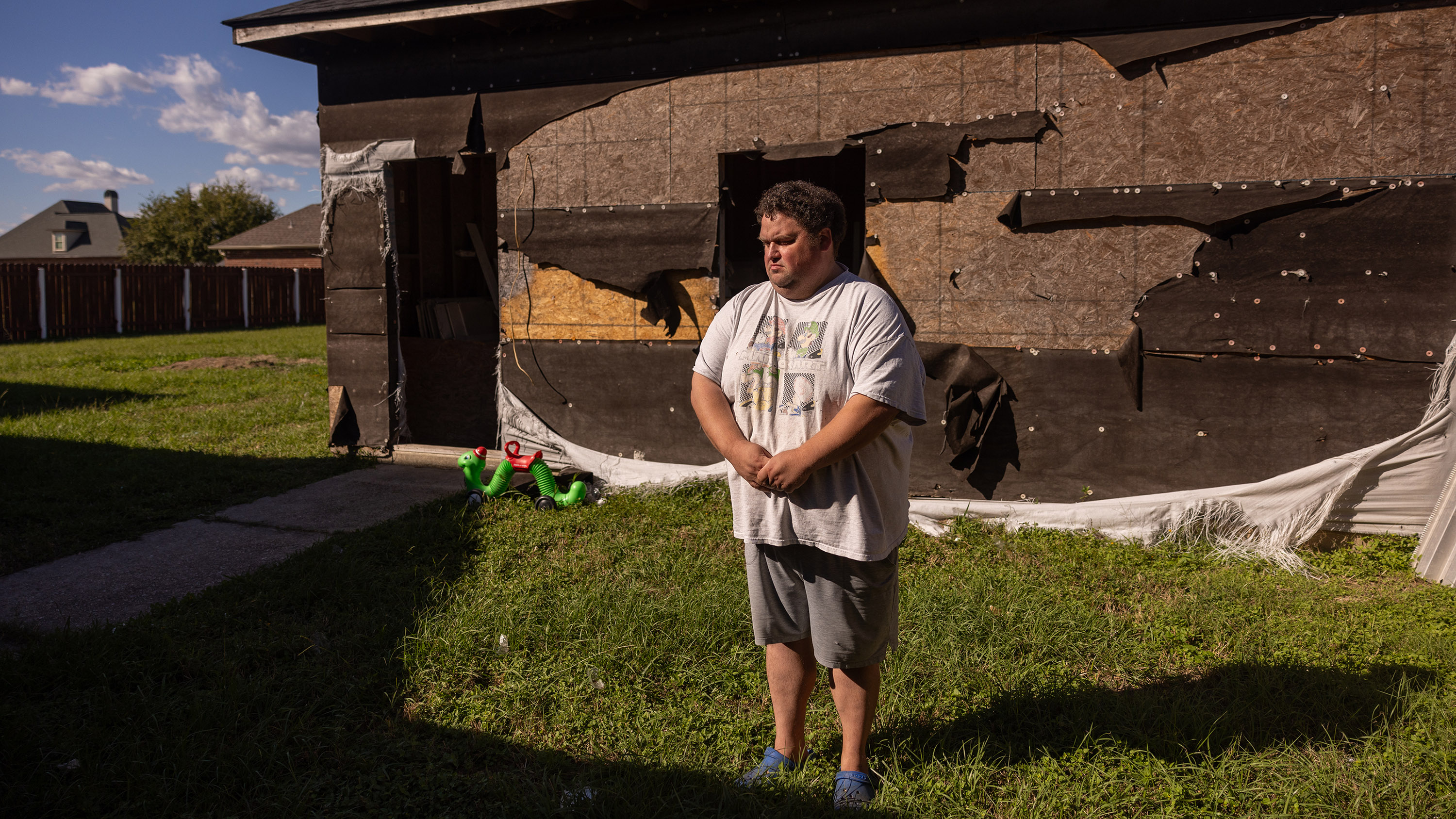
Much of that belief stems from the fact that despite repeated calls for help, the black goo still clings to walls, roofs, and soil of more than half of the town’s properties, according to Van Showers, the mayor of Roseland, Louisiana.
“People want to know when they’re going to receive help, and there is nothing to make them think that this process would lead to that,” said Showers, who works at a local chicken processing plant and has struggled financially through the clean-up process.
That skepticism is rooted in hard experience — and in a broader history of environmental racism that has left Black communities shouldering disproportionate burdens. The gap has left residents in a state of prolonged uncertainty about their water, their health, and whether the legal action unfolding in distant courtrooms will ever reach their homes. It is a familiar pattern, particularly in Louisiana, where environmental disasters have consistently hit Black and low-income communities hardest while leaving them last in line for recovery.
Initially, residents in the town, where the average person earns just $17,000 per year, were told to clean up the mess themselves.
The explosion had sprayed the community of 1,100 residents with dozens of chemicals, including cancer-causing ones known as PFAS, or “forever chemicals.” One resident living on a fixed income told Capital B that in the weeks after the event she went over $1,000 in credit card debt to replace the stained panels on her trailer.
However, in October, after sustained pressure from residents, the tide seemed to turn. Federal and state agencies ramped up their presence in the disaster zone, canvassed the community, brought the lawsuit, and began testing wildlife — including fish and deer — for contamination.
But even with the increased governmental response, attorneys, residents, and local officials warn that it is not nearly enough. The lawsuit compensation, if ever paid out, will most likely not trickle down to residents, Showers and local lawyers said. Civil penalties collected from federal lawsuits are generally deposited into the U.S. Treasury’s general fund and are often used exclusively to fund environmental cleanup costs, not to support residents.
“As far as the lawsuit, I don’t think it’s going to benefit the community,” Showers said.
The government’s suit alleges that for years, Smitty’s knowingly violated safety rules and pollution permits. The company failed to maintain basic spill-prevention and emergency response plans, regulators said.
The complaint says millions of gallons of contaminated firefighting water, oil, and chemicals flowed off-site into ditches, and seeks more than $1 billion in fines and penalties tied to the explosion and spill.
In response to the lawsuit, a representative of Smitty’s wrote, “Smitty’s has been and remains committed to following all applicable laws and regulations, and to operating as a responsible member of the Tangipahoa Parish community.”
The disaster was the “result of an unforeseen industrial fire,” the representative added, and the company is “implementing measures to help prevent future incidents and protect our waterways and neighbors.”
Yet even since the lawsuit was brought, according to state documents, Smitty’s was caught pumping unpermitted “oily liquids” into local waterways.
Meanwhile, a recent Louisiana Department of Environmental Quality report shows a state contractor has recovered at least 74 live wild animals from the disaster zone and 59 of them had either digested the oily substance or were covered in it. At least eight animals were found dead, including four turtles and an alligator.
Dozens more pets and livestock, including cattle and horses, have been coated in the residue. Many residents, including Showers, have seen their animals die. Those findings, combined with reports of stillborn calves, underscore how deeply the contamination has seeped into daily life, residents said.
The explosion has not only unleashed lasting environmental and health threats — the kind that, as Showers worries, “can lay dormant for years and then all of a sudden … you start getting a lot of folks with cancer” — it has also shuttered Roseland’s largest employer, Smitty’s Supply, indefinitely.

Adam Mahoney / Capital B
For weeks after the explosion, Millie Simmons, a 58-year-old child care worker, had difficulty being outside in Roseland for longer than 10 minutes without respiratory irritation. Even when inside her home, she felt “drained” and “sluggish” for weeks.
Showers said she is not alone. The biggest complaints he is still receiving are that “people are still sick” and “want to know when they’re going to receive help as far as getting their property cleaned.”
“Most definitely, we deserve something,” Simmons said.
A nation’s environmental divide
In October, the federal government delegated the cleanup process entirely to the state and Smitty’s. Some residents say they have seen Smitty’s contractors cleaning a few properties, but others, including the mayor, say their claims have gone unanswered. Showers said the company reimbursed him for just one night in a hotel when he was forced to leave the town after the explosion and never responded to his request for compensation after a litter of his dogs fell ill and died in the weeks after.
Advocates with the Louisiana Environmental Action Network, or LEAN, who have notified Smitty’s and federal and state environmental regulators of their intent to sue, said residents continue to approach them about contaminated crops and water wells. They’re unsure if their water is safe, even months later.
“There’s so many unanswered questions that bring such huge anxiety to the communities,” said Marylee Orr, LEAN’s executive director. “People don’t feel safe in their homes.”

Courtesy of Van Showers
Orr said she is especially worried that the courtroom path now unfolding will repeat familiar patterns from other environmental disasters.
In places like Grand Bois in south Louisiana and in Flint, Michigan, she noted, residents waited years for historic settlements to turn into actual checks they could cash — only to see large portions of the money eaten up by legal fees. In Flint, residents have waited over a decade for compensation for the country’s most notorious water crisis that caused clusters of neurological and developmental issues among children. When it is all said and done, only a portion of the impacted residents will receive checks for about $1,000.
In Roseland, Showers has found himself operating in an information vacuum. He is relying more on outside news reports than official briefings to learn the full extent of contamination in his own town. In fact, he did not know about the state report showing the harms to local animals until Capital B shared it with him.
“No one from the government has ever told me anything,” he said. “It’s aggravating.”
That lack of transparency makes it harder, he added, to answer the basic questions residents bring to him at the grocery store, at church, and outside town hall: “Is my water safe? What’s happening to the animals? Am I going to be OK?”

Courtesy of the City of Roseland
This is a dynamic that reflects both the long-standing political dynamics of Louisiana and deepening uncertainty under the Trump administration.
His position as a Black Democrat leading a majority-Black town in a state dominated by white, conservative leadership has only intensified that isolation, he told Capital B in September.
Historically Black communities have received less recovery aid than white areas with comparable damage during environmental disasters. Now, experts warn that federal support for environmental disasters in Black and Democratic areas is poised to weaken even further under the Trump administration, which has slashed EPA and DOJ enforcement to historic lows.
During the first 11 months of Trump’s second term, the EPA and DOJ have filed just 20 enforcement actions against polluters, imposing $15.1 million in penalties. During the final 19 days of the Biden administration last January, the EPA and DOJ imposed $590 million in penalties.
The current administration has also instructed EPA officials not to consider whether affected communities are “minority or low-income populations” when prioritizing enforcement actions.
Showers estimates that fewer than three-quarters of properties have been cleaned and that many residents who dutifully called the claims hotline are still living with stained roofs, sticky yards, and lingering health problems.
“There’s just not enough information being put out or work being done to make people feel at ease about what’s going on.”
Source link
Adam Mahoney, Capital B grist.org