
When the snow starts falling, it’s tempting to retreat into the house and hibernate until spring. But no matter how tempting, it is unfortunately not possible. Even if we didn’t have to go to work, regulations in most communities hold individuals responsible for clearing the sidewalks in front of their homes.
There is a lot of conflicting advice about the best way to clear a sidewalk, and most of it doesn’t consider environmental impacts. But we do.
This article contains affiliate links. If you purchase an item through one of these links, we receive a small commission that helps fund our Recycling Directory.
Know Your Conditions
The best way to clear snow depends on what kind of snow you have. You may only need a shovel for clearing dry, powdery snow, or you may need de-icer even if your snow doesn’t stick. Take snow advice with a grain of salt. Better yet, avoid the salt because it can pollute your local water supply — but always do consider your own snow conditions.
Safety First
Avoiding chemicals is usually the safest choice. Don’t use de-icer if simply shoveling snow will work. If you don’t get snow often, you can cover the sidewalk with a tarp when snow is expected. After the snow stops, lift the tarp for a clear pathway.
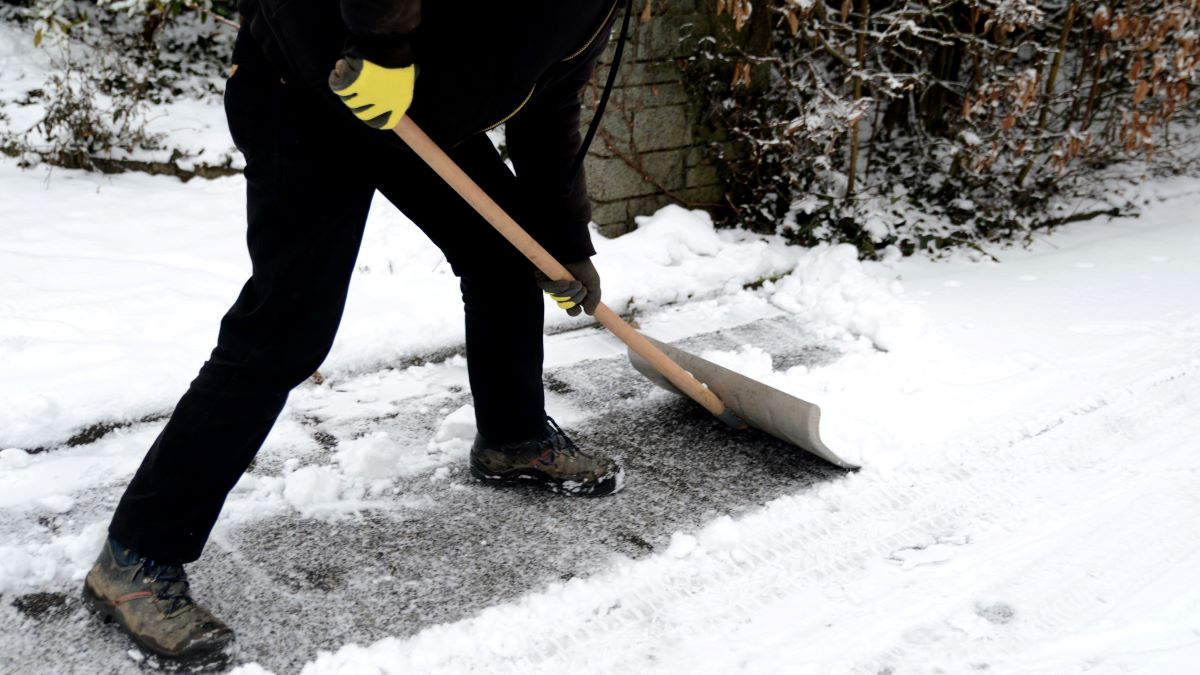
If shoveling is necessary, learn how to do it safely without injury. Lifestyle hackers sometimes recommend shop vacs or leaf blowers instead of shovels for snow removal. Unless you are physically unable to shovel snow (and cannot find someone who can do it for you) it’s best to avoid polluting machinery.
If you must use de-icer, use the smallest effective amount and apply it only where necessary. That said, for areas like driveways and sidewalks that you do clear, do the job right. Clearing a path only as wide as a snow shovel does not benefit wheelchair users, people with mobility issues, or adults holding a child’s hand or pushing a stroller. Provide a wider path and clear curb cuts to keep your sidewalk safe for everyone.
Traction
Before reaching for de-icer, consider materials like sandbox sand or kitty litter that won’t melt ice but can provide traction. Fireplace ash is another choice; depending on your soil type, this could be beneficial to your plants. Alfalfa meal is another material that may serve as a fertilizer while also providing traction.
Another suggestion came from Marty Bechina, an Earth911 reader, who uses bird seed to get traction in the snow. “It not only does the same work but is environmentally friendly as well as friendly to our feathered friends,” Marty wrote. “We just use a basic inexpensive mix – there are usually some sunflower seeds as well as cracked corn. For traction, it’s usually best to not have a mixture of all round seeds. The odd size seeds give better grip.” Thanks for the tip!
De-icers: Expanding Possibilities
The EPA maintains a list of de-icers that meet their Safer Choice Standards. These Safer Choice standards do not guarantee absolute safety to humans, pets, and the environment. But they do exclude the most harmful ingredients while assuring comparable product performance.
We also recently discovered an environmentally benign sidewalk de-icing made from invasive starfish, Star’s Tech ECO-ST. This de-icing product, which began as a high school science project, is made from starfish skeletons that melts ice faster than conventional rock salt while significantly reducing chloride pollution.
In Korean waters, the Northern Pacific sea star has become such a menace to shellfish aquaculture that the government purchases 3,000 to 4,000 tons annually to control populations. Star’s Tech upcycles about 10% of that collected material, extracting the porous calcium carbonate structures that give starfish their shape and their remarkable ability to store and release chloride in a controlled manner. ECO-ST is available on Amazon in the U.S. and Canada, with retail partnerships launching this winter. Learn more at starstech.co.
DIY De-icing
A popular and relatively safe DIY de-icer uses dish soap and rubbing alcohol diluted in hot water.
Be the Good Neighbor!
Elderly or physically limited neighbors can’t apply your new de-icing knowledge without risking injury. About 100 Americans die shoveling snow every year. If you can make the time, offer to help clear a neighbor’s sidewalk to help prevent falls or worse. It’s a great way to establish a new relationship and make your community a better place.
Editor’s Note: Originally published on January 9, 2020, this article was most recently updated in December 2025.
Source link
Gemma Alexander earth911.com
