
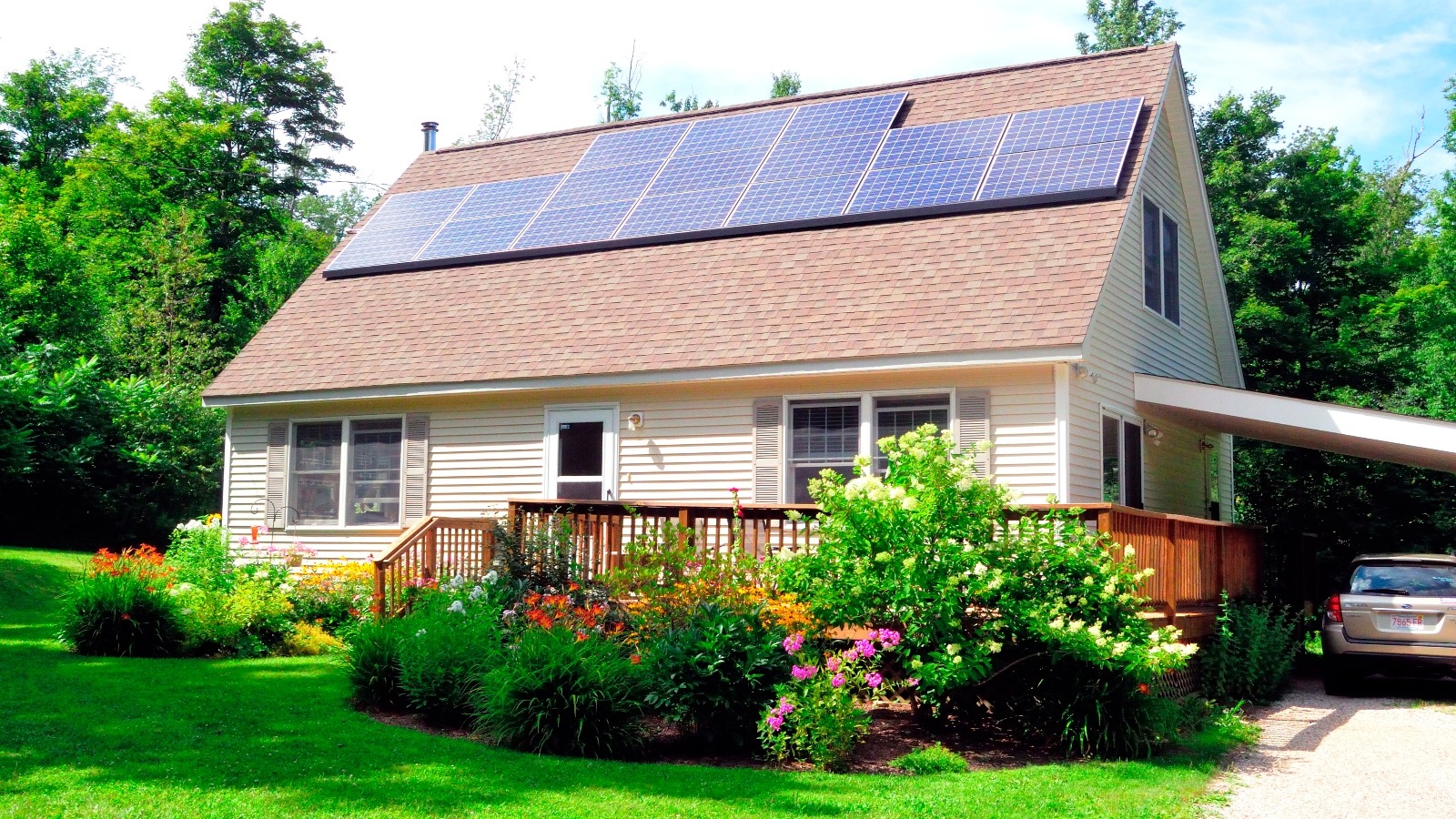
New Hampshire Republicans are attempting to do away with a 50-year-old property tax exemption for households and businesses with solar, contending that the policy forces residents without the clean energy systems to unwittingly subsidize those who have them. Supporters of the exemption, however, say this argument is misleading, insulting, and at odds with New Hampshire’s tradition of letting communities shape their own local governments.
The focus of the debate is a bill proposed in the New Hampshire House this month by Republican Representative Len Turcotte and several co-sponsors in his party. The measure would repeal a law, established in 1975, that authorizes cities and towns to exempt owners of solar-equipped buildings from paying taxes on whatever value their solar systems add to their property. As of 2024, 153 of the state’s municipalities — roughly two-thirds — had adopted the exemption, one of the only incentives offered in support of residential solar power in the state.
The exemption means that homeowners without solar must pay more property tax to make up for the money not being collected from the “extreme minority” who have solar panels, Turcotte said while presenting his legislation at a hearing of the House Science, Technology, and Energy Committee last week. This “redistribution” of the tax burden is unfair, he said.
The solar property tax exemption is a fairly common policy: Nationally, 36 states offer some version of it. While legislators in many states have targeted pro-solar policies like net metering, property tax exemptions have so far avoided similar attacks. New Hampshire, therefore, could end up as a proving ground for whether this approach can find traction.
New Hampshire does not have a sales tax or an income tax and leans heavily on local property taxes for revenue; its rates are among the highest in the country. That makes changes to property tax policy a particularly sensitive subject. The solar exemption bill has Republicans, who are typically tax averse, walking a fine line between championing what they say is fairness for all and pushing a policy that will inevitably raise taxes for some.
The state authorizes 15 other property tax exemptions — including for elderly residents, veterans, and those with disabilities — but Turcotte’s bill targets only the one for solar.
The exemption is a “local option” policy, meaning cities and towns must opt in through a vote in each municipality. Turcotte, however, doubts the average resident realized that they were signing up to pay more on their own taxes.
“They see a feel-good measure,” he said. “Do they truly understand? I don’t believe they do.”
After Turcotte presented his bill, the remaining speakers — about a dozen clean energy advocates, lawmakers, business leaders, and local solar owners — uniformly opposed his proposal.

Removing the exemption would be an unfair rule change after homeowners invested in solar systems with the understanding they’d be getting a tax break, many argued. Businesses using solar could face a “significant tax increase,” said Natch Greyes, vice president of public policy at New Hampshire’s Business and Industry Association. The change could cost homeowners with solar hundreds of dollars per year while barely reducing the property tax rate for everyone else, others said.
In the town of Hudson, for example, $2.2 million in property value isn’t taxed because of the exemption, out of a tax base of $5.1 billion, its chief assessor, James Michaud, testified. Removing the exemption would have virtually no effect on the tax rate, he said.
“It’s almost incalculable how small it is,” he said.
Whatever tiny tax shift the exemption creates is worth it, others argued, saying that it provides an incentive for the public good: More solar means lower greenhouse gas emissions and less burden on the grid. Turcotte countered that these broader benefits of solar — many of which have been well documented — are “subjective.”
The question of local control also loomed large in the testimony. In New Hampshire, whose motto is “Live Free or Die,” the right of individual towns to decide on their own rules and regulations has long been a point of pride. Repealing the exemption would mean overriding decisions made by voters. Turcotte’s claim that residents didn’t understand what they were getting into is not only condescending but also just plain wrong, several witnesses said.
“You are essentially, with this bill, substituting your judgment about what is proper at the level of local taxation for that of town meetings and city councils throughout the state,” said Representative Ned Raynolds, a Democrat, while questioning Turcotte.
The bill now awaits a vote in committee before it can face a floor vote from the full House. It would then advance to the Senate. Republicans control both chambers of the state Legislature and the governor’s office.
But the bill’s opponents hope that lawmakers will heed their arguments and give weight to the mass of voters who have approved the exemption across the state.
“This is the reason two-thirds of the towns have adopted it: They can see it’s a good thing,” testified David Trumble, a solar owner from the town of Weare. “Solar is a good thing.”
Source link
Sarah Shemkus, Canary Media grist.org
