
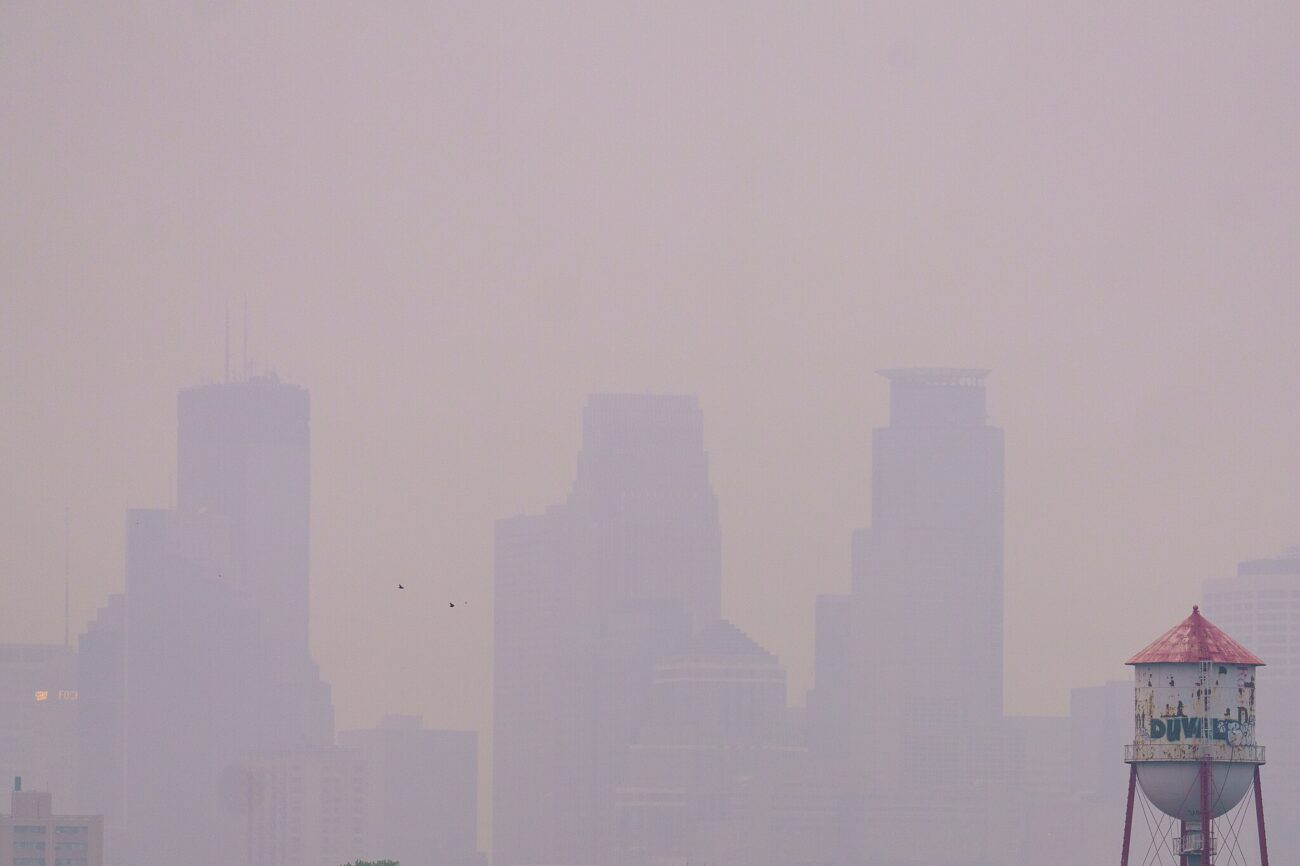
A new analysis of air quality data from the past 70 years shows that Canada’s record wildfire smoke in 2023 is part of a broader, continent-wide trend toward smokier skies across North America.
“What we found is a big east-to-west shift,” says lead author Robert D. Field, an associate research scientist at the NASA Goddard Institute for Space Studies, part of the Columbia Climate School. “Air quality improved in the east as industrial emissions dropped, and at the same time it degraded in the west because of more fire.”
Published in Earth’s Future, the paper includes a review of climate projection studies indicating that, on average, warming is likely to continue to lead to drier, more fire-prone summers across many parts of Canada. Although the projected changes may differ by region, and it’s not certain how burned areas will change in the future, the projections align with the increases in burned area seen over the past decade.
The findings point to a future in which fire-weather conditions driven by climate change play a growing role in shaping summer air quality in both the United States and Canada. Wildfire smoke is a public health concern because it can’t be reduced through the same regulatory tools used to address fossil fuel pollution.
While the study does not estimate health impacts itself, it draws on earlier research showing that smoke has caused health problems in Canada and other countries. One recent analysis found that wildfire smoke contributes to approximately 40,000 deaths each year in the U.S. alone.
Multiple data sets confirm a record-breaking season
The study draws on a large set of long-term data to analyze smoke in Canada. It includes atmospheric measurements from five satellite instruments beginning in 2001, weather station reports of “smoke” and “haze” dating to 1953, and national records of burned areas since 1959. Together, these records show that 2023 had the highest smoke levels in 20 years of satellite measurements and the most smoke and haze reports in seven decades of surface observations. Twelve out of Canada’s 13 provinces and territories set new records for wildfire smoke in 2023. Nearly 15 million hectares burned across the country—an area the size of New York State and more than twice the previous national record.
The trend has continued. Preliminary updates show that fires burned nearly 5 million hectares in 2024 and 8 million hectares in 2025.
Long-term data also demonstrate how air quality concerns have changed by region. In eastern Canada, summer smoke and haze decreased from the 1970s through the early 2000s as sulfur dioxide and nitrogen oxide emissions fell under air-quality regulations in Canada and the U.S., chief among them the Clean Air Act amendments starting in 1970. Cleaner industrial operations and reduced vehicle emissions helped improve air quality.
Western and northern Canada now show the opposite trend: Beginning in the 2000s, more severe wildfires and greater burned area contributed to increased summertime smoke. This shift parallels changes in the western U.S., where wildfire activity has grown, and smoke is now a dominant driver of poor summer air quality.
Canada’s 2023 fire season began during a time of hot, dry weather and unusually synchronized high fire danger across several provinces. The study points to earlier attribution work showing that climate change made these conditions more likely, particularly in eastern Canada in May and June of that year. The authors didn’t conduct a new attribution analysis but referenced this work to place the 2023 season within broader climate trends, i.e., that 2023, 2024 and 2025 were the three warmest years globally since record keeping began in 1880.
Preparing communities for smokier summer air
“The wildfire season of 2023 clearly demonstrated that the eastern side of the continent is also susceptible to severe air quality impacts,” says coauthor Sarah B. Henderson, scientific director of environmental health services at the British Columbia Centre for Disease Control. “Since then, Canada has experienced two more severe wildfire seasons that have affected air quality throughout North America. We urgently need to develop cohesive policies, programs, and practices that protect people and populations from exposure to wildfire smoke in the United States, Canada and beyond.”
The study notes that better smoke monitoring and forecasting can help communities prepare when air quality is expected to worsen, but long-term resilience will depend on broader public health measures. Field says ensuring that people have access to clean indoor air through home filtration, public clean-air shelters or other approaches will be crucial as wildfire smoke becomes more common during North American summers.
The study was coauthored by Olivia E. Clifton and Konstantinos Tsigaridis of the NASA Goddard Institute for Space Studies; Hiren Jethva and Pamela A. Wales of Morgan State University; Tempest McCabe, Douglas C. Morton, Elijah Orland, Melanie Follette-Cook, Robert C. Levy, Lesley Ott, and Omar Torres of the NASA Goddard Space Flight Center; Sarah B. Henderson of the British Columbia Centre for Disease Control; Norah A. MacKendrick of Rutgers University; Cordy Tymstra of Thompson Rivers University; and Piyush Jain of Natural Resources Canada’s Canadian Forest Service.
Source link
Columbia Climate School news.climate.columbia.edu



.jpg)