
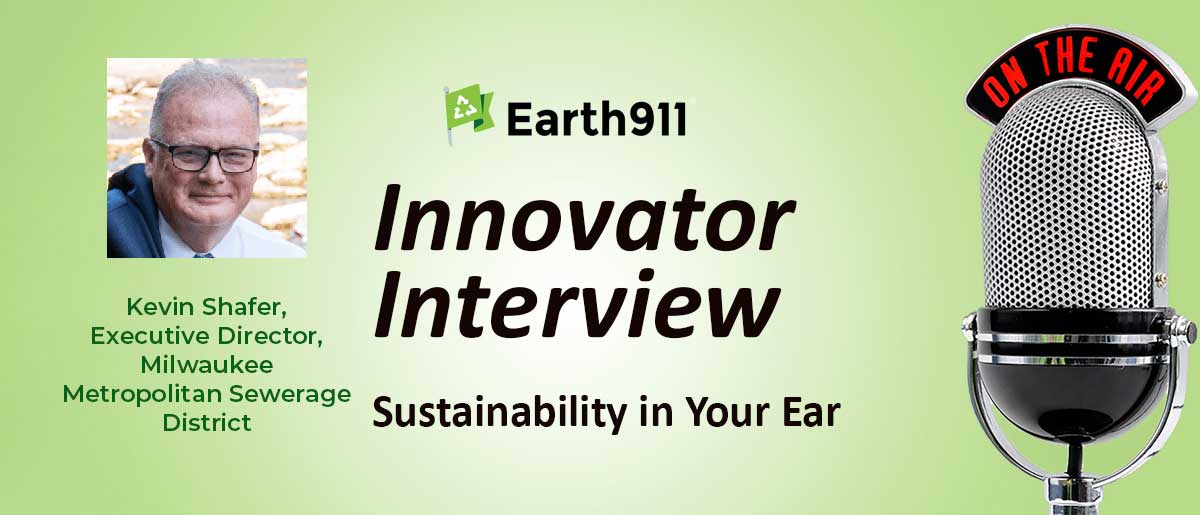
Milwaukee’s circular approach actually predates the term by nearly a century. In 1926, the district began producing Milorganite—Milwaukee organic nitrogen—a fertilizer made from dried biosolids that most utilities simply spread on fields or incinerate. Today, that product returns $11 to $12 million annually to the city’s budget while keeping waste out of landfills. Kevin explains that this foundational commitment to doing the right thing has shaped MMSD’s culture ever since: ‘We just always look at those type of approaches. It’s foundational to the district.’
The district’s eight digesters at its South Shore plant now generate 80 to 85% of the facility’s electricity from biosolids, with enough material left over to continue making Milorganite. Kevin calls it Cradle to Cradle in action, referring to the philosophy pioneered by architect William McDonough, who visited MMSD in 2006 and was intrigued by work that predated his framework by decades. The district is also partnering with regional breweries and food processors, accepting their organic waste streams for co-digestion. This reduces disposal costs for industry partners while increasing energy production—a synergy that Kevin sees as the future of utility operations.
Looking ahead, Kevin’s 2035 vision targets 100% renewable energy and a 90% carbon reduction compared to 2005. He argues that utilities should see themselves as anchor institutions with generational responsibilities: ‘I won’t be here 50 years from now, but MMSD will be.’ That long view has attracted new partners. ‘All of a sudden they say, oh, here’s someone that’s thinking a little bit differently about something, and maybe we can help them, or they can help us.’ The key barrier to scaling the circular economy, he believes, isn’t technology—it’s institutional culture and a narrow focus on regulatory compliance rather than systems thinking.
You can learn more about the Milwaukee Metropolitan Sewerage District at mmsd.com.
Source link
Mitch Ratcliffe earth911.com
