
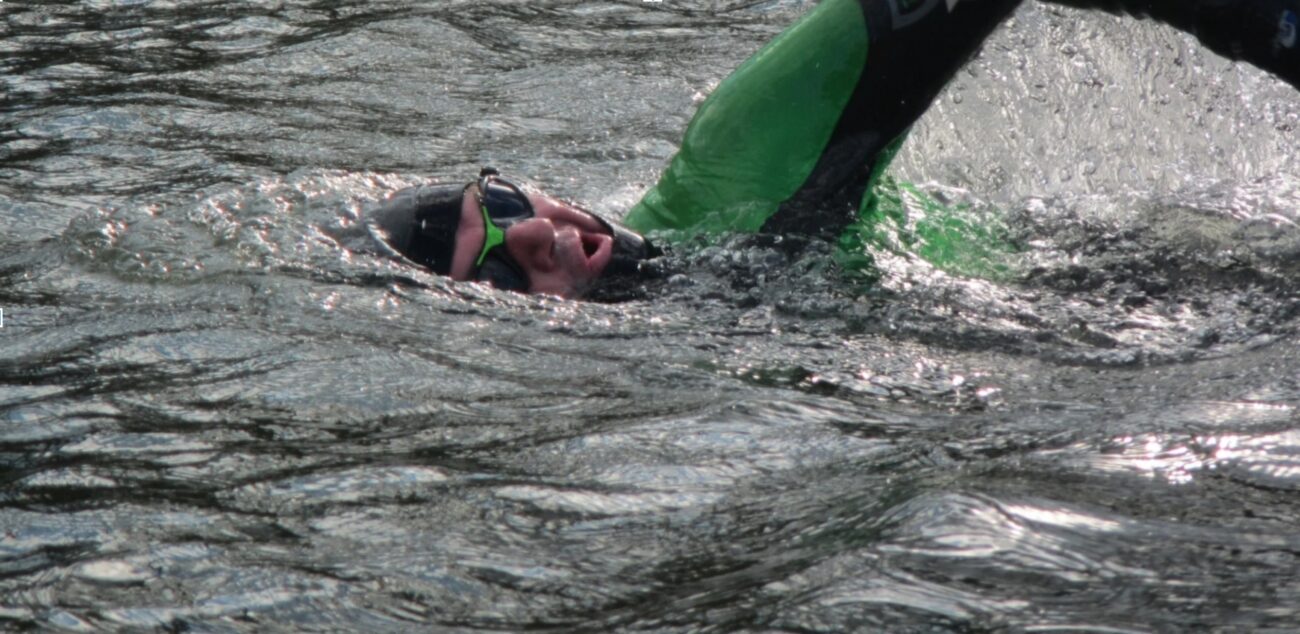
Christopher Swain’s deep relationship with water began as a child. He recalls splashing around in the water, searching for the protruding edge of a pirate’s gold chest along the shores of Massachusetts, and feeling an almost spiritual connection to the ocean. For Swain, the water has always been a place of belonging. His sunlit childhood memories of the ocean later shaped his life’s mission to protect water and the natural world.
In 1995, inspired by reading the Universal Declaration of Human Rights, Swain walked 200 miles along the length of Massachusetts, holding a prototype Olympic torch and distributing copies of the declaration. This endeavor introduced him to the power of engaging people through symbolic action. But it also sparked a realization that his next journey should connect directly to the element he loved most: water. The next year, he swam 200 miles down the Connecticut River to promote the declaration. This effort unexpectedly drew public attention to water pollution and environmental issues, he says, and ultimately, the experience planted the seed for what became his life’s work: swimming long, polluted rivers to advocate for clean water and environmental justice.
In 1997, Swain fell in love with the Columbia River after coming across the Lewis and Clark journals. This inspired him to swim all 1,243 miles of the Columbia over the course of 165 days, from 2002 to 2003. He found himself immersed in the physical challenge of the swim, alongside the stories of the people who lived along the river. Through conversations with Indigenous leaders, Swain developed an understanding of the cultural interconnectedness Indigenous peoples feel with the environment, he says. Their stories reshaped his worldview, he adds, and taught him that “the illusion of separateness between humans and nature is the root of the environmental crisis.”
Swain’s swims are more than athletic achievements, he says—they are also acts of storytelling. He believes that stories have the power to transcend political and emotional barriers, ultimately uniting people. He emphasizes that the shared affection for the natural world is a point of connection rather than a divide. For Swain, this shared love for the environment is the foundation for meaningful environmental action.
The physical toll of his swims has been substantial. Swain has encountered multiple ear infections, colds, collisions with boats and more. But he views these hardships as part of his pact with the water. Each river he has swam has become a living being to him, he says.
So far, Swain is the first person to swim the full length of major polluted water bodies. These include the Columbia, Hudson, Mohawk, Charles, Mystic, East and Boise rivers, as well as Lake Champlain, Gowanus Canal, Newtown Creek, Long Island Sound and Narragansett Bay.
Today, as a student in the M.A. in Climate and Society program at Columbia’s Climate School, Swain is able to synthesize his experiential knowledge with academic training to inform environmental policy. His goal is to secure a “place at the table where the future of the living world is negotiated,” he says.
Currently, Swain is promoting a proposed U.S. constitutional amendment to protect the rights of nature, the climate and future generations. He argues that while the science and data supporting the need for environmental protection is well established, the real challenge lies in social and political will. Swain sees storytelling as a way to overcome fear, dissolve polarization and drive collective protection of the natural world. “It’s not enough to care,” he says. “You gotta be courageous…I want to bind courage to care.”
Source link
Columbia Climate School news.climate.columbia.edu
