
In just one year, President Donald Trump has fundamentally changed the arc of federal climate and environmental policy.
Upon returning to office 12 months ago, Trump immediately declared an “energy emergency” and promised to “unleash American energy.” He packed his cabinet with oil executives and climate skeptics who have since rolled back the climate initiatives and protections of presidents Obama and Biden while accelerating fossil fuel development.
From dismantling regulations designed to cut emissions and tame pollution to repealing the country’s most ambitious climate action, Trump has reveled in reversing years of progress. He has withdrawn from both the Paris Agreement and the U.N. Framework Convention on Climate Change and undercut scientific research at every opportunity.
This retrenchment came even as much of the world moved forward in 2025. Worldwide, renewables provided 40 percent of all electricity. Coal-fired power generation declined in India and China for the first time in two generations. Global clean energy investment was 50 percent higher than fossil fuel investment. Still, the United States has clearly ceded leadership in the climate fight. These seven charts reflect a year with implications that will be felt for a long time to come.
Electric vehicle sales by company, 2022–2025
Tesla (U.S.)
BYD (China)
Geely (China)
VW Group (Germany)
GM (U.S.)
The first year of Trump 2.0 brought sweeping changes to Washington’s view of electric vehicles, and American automakers felt the squeeze.
President Donald Trump and Congress took several steps to eliminate federal support for it, including eliminating the $7,500 consumer tax credit. The administration also slashed fuel-economy targets — from about 50 mpg by 2031 to roughly 35 — and eliminated penalties for automakers that miss efficiency standards. The combined effect: higher prices for many electric vehicles built in the United States, uncertainty around battery and manufacturing investments, and a weaker regulatory push that now favors hybrids and conventional vehicles. EV market share in the country, which briefly topped 10 percent in the third quarter as buyers rushed to claim the expiring credit, has since fallen to single digits.
Meanwhile, the global EV industry continues to accelerate, making the U.S. retreat look like a concession to China — and, to a lesser extent, Europe. Chinese industrial policy continues driving down costs, with industry giants CATL and BYD now supplying more than half of the world’s batteries. BYD overtook Tesla as the world’s best-selling EV manufacturer, selling 2.26 million cars in 2025 compared to Tesla’s 1.64 million. In the United States, Ford announced a $19.5 billion write-down, killed the F-150 Lightning pickup, and planned a pivot toward hybrids, citing federal policy changes as the primary driver. There was one bright spot in the data, though: The price gap between used internal combustion and electric vehicles is rapidly narrowing, and as of August it reached a record low of just $897. A glut of used EVs are also expected to hit the market over the next few years, which could drive prices down even further.
So: The first year of Trump’s second term hasn’t exactly decimated the American EV industry, but it has transformed what might have been a sustained industrial policy push into a landscape of slow growth, rapid market shifts, and further consolidation of China’s manufacturing and battery supply chains.
– Clayton Aldern, senior data reporter
U.S. quarterly electricity generation in terawatt-hours, 2010–2025
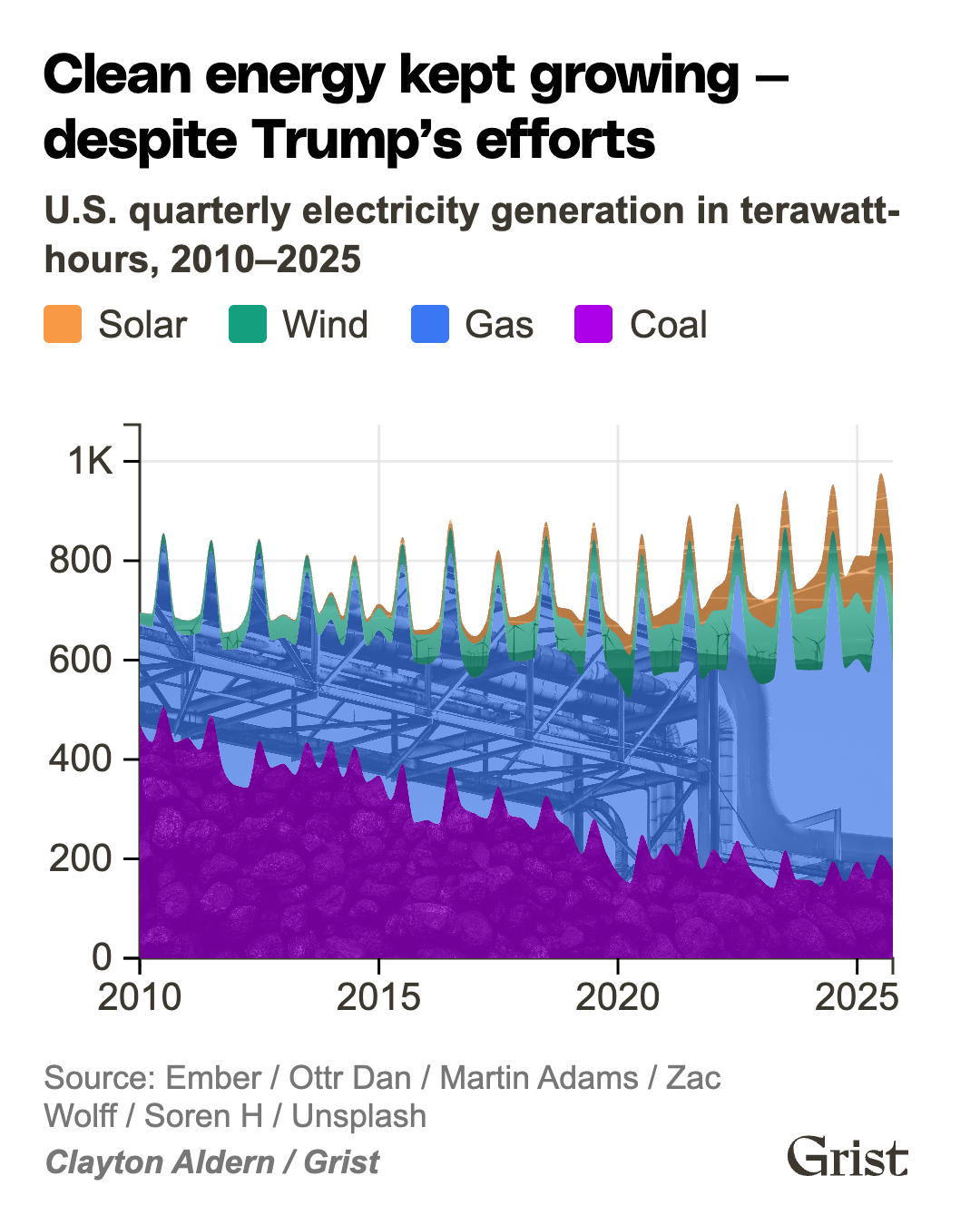
One of the more counterintuitive aspects of climate change is that cutting greenhouse gas emissions often requires more energy, not less. That’s because of electrification: Technologies like induction stoves, heat pumps for homes and factories, and electric cars all draw the grid. At the same time, the rise of artificial intelligence requires ever more power-hungry data centers, further straining the electrical system. Yet in the first year of its second term, the Trump administration did everything in its power to slow the rollout of renewables like wind and solar, and even stalled several offshore wind projects already under development — even as rising electricity demand made them increasingly necessary.
But even against these political headwinds, green energy continued to surge. States like California and Texas kept expanding solar, wind, and storage capacity, showing that market economics outweigh federal roadblocks. Electricity demand in the United States grew 3.1 percent last year, according to energy think tank Ember. At the same time, solar generation rose by 27 percent, meeting nearly two-thirds of that extra demand. Utilities have also been building huge battery banks to store that juice for use when the sun isn’t shining: California added nearly 70 percent more storage capacity in 2024 than the year before.
While it will take time to suss out the Trump administration’s impact on this energy transition, it’s clear that market forces remain a powerful driver for states that understand that a cleaner grid is a cheaper, more reliable grid.
– Matt Simon, senior staff writer
Quarterly federal disbursements on hazard mitigation projects
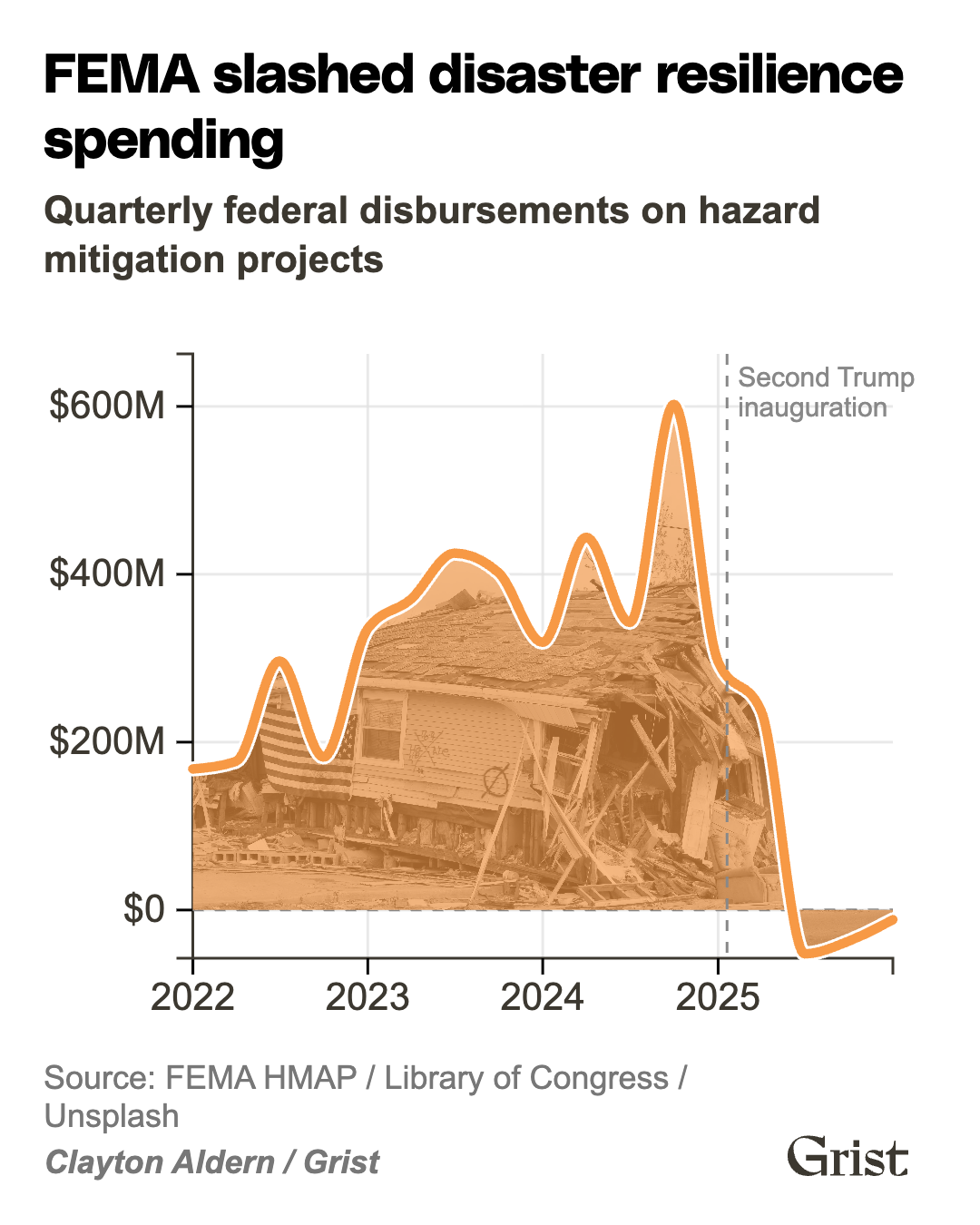
The Federal Emergency Management Agency often makes headlines during disasters, but in recent years it also has spent billions helping hundreds of communities prepare for future catastrophes. The agency has long doled out grants to alleviate floods in low-lying areas and weatherize against storms, and under the Biden administration it launched new programs to build resilience against climate-fueled threats like wildfires and extreme heat. These programs have provided money to elevate thousands of homes in low-lying areas, manage flammable vegetation, and upgrade sewers to handle runoff from freak storms.
That effort came to a stop earlier this year after Trump vowed to shrink federal spending. Homeland Security Secretary Kristi Noem announced all FEMA payments above $100,000 would require her approval, reportedly creating a billion-dollar backlog of transactions. Quarterly spending on the program fell from a peak of around $500 million under Biden to less than zero last year as FEMA clawed back money from some recipients.
The agency also has halted all new approvals for resilience projects. FEMA has continued to endorse new projects that don’t have an explicit climate focus, like installing backup generators and drafting disaster response plans, but it has shut down the Biden-era Building Resilient Infrastructure and Communities program, which funded long-term investments to reduce climate-related risks. FEMA does not appear to have approved a single project under that program since Trump’s inauguration, despite a federal court ruling in December ordering it to continue the program.
– Jake Bittle, staff writer
EPA actions taken, first 9 months of presidential administration
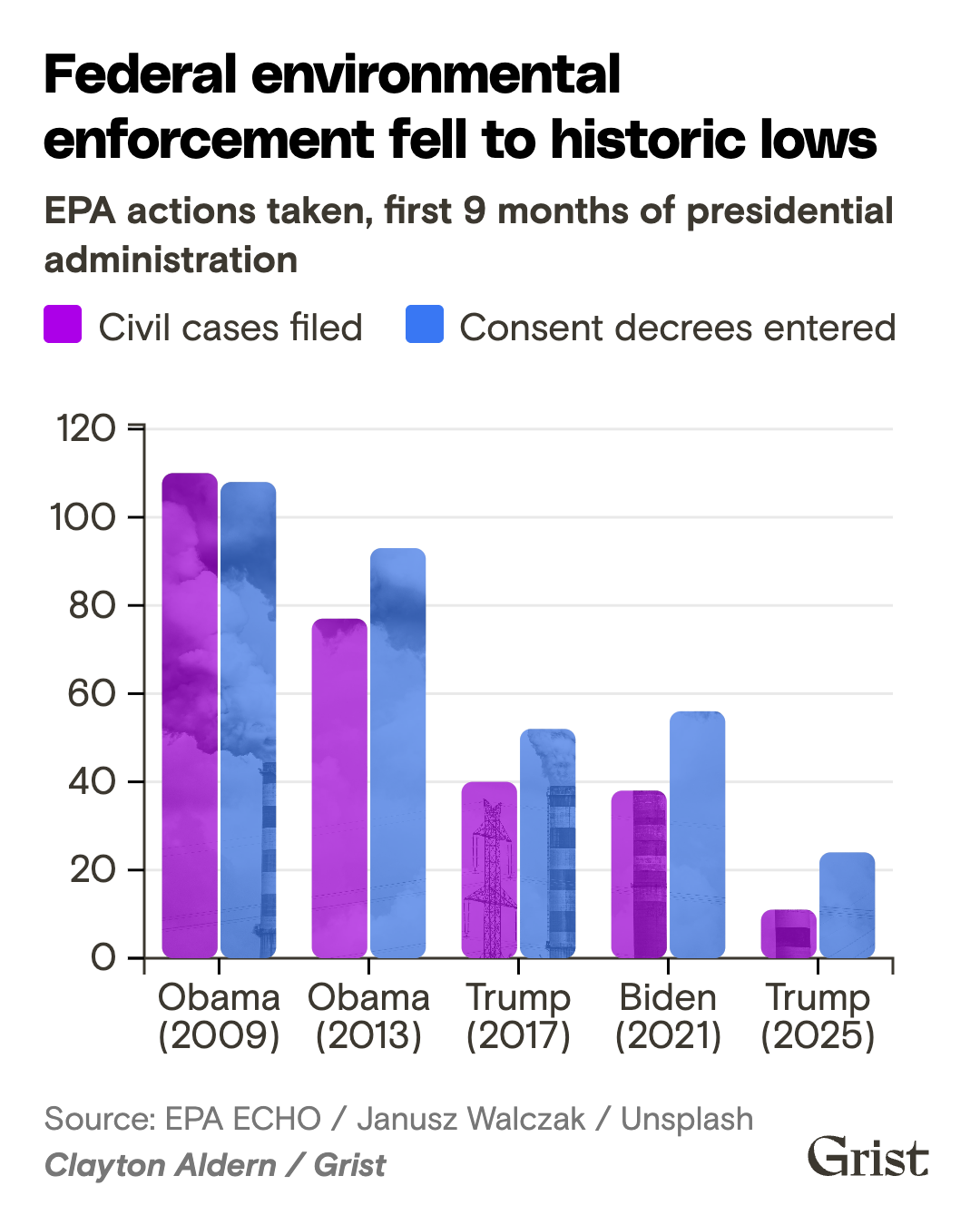
The country’s bedrock environmental laws are only as strong as their enforcement. The Environmental Protection Agency and the Department of Justice, working alongside their state counterparts, are responsible for protecting the public and holding polluters accountable. But over the past year, the Trump administration has dismantled those agencies with sweeping layoffs and budget cuts, undercutting their ability to fulfill their missions.
More than 11,500 employees of the two agencies have been laid off or resigned, including dozens from enforcement divisions. That’s left fewer federal inspectors to track pollution and fewer attorneys to pursue violators.
That pullback is already reshaping how often — and how forcefully — the government goes after polluters. Over the first nine months of both Trump’s first term and the Biden presidency, the Justice Department launched roughly 40 civil enforcement cases against polluters. During the same stretch last year, it initiated just 11. The slowdown extends to prosecutions as well. Under the previous two administrations, the number of consent decrees resulting from federal cases typically hovered around 50. Last year, that figure fell to just 24, weakening one of the federal government’s most effective tools for forcing cleanup and compliance.
The retreat deepens a decades-long erosion in regulatory oversight. According to the Environmental Integrity Project, many state environmental agencies — which carry out much of the day-to-day enforcement of such laws — have seen their funding for that work slashed. Between 2010 and 2024, those budgets declined in more than half of all U.S. states, and by more than one-third in at least seven. With federal enforcement budgets also being reduced, oversight is shrinking at every level of government.
– Naveena Sadasivam, senior staff writer
Administration actions to remove or weaken protections, 2025
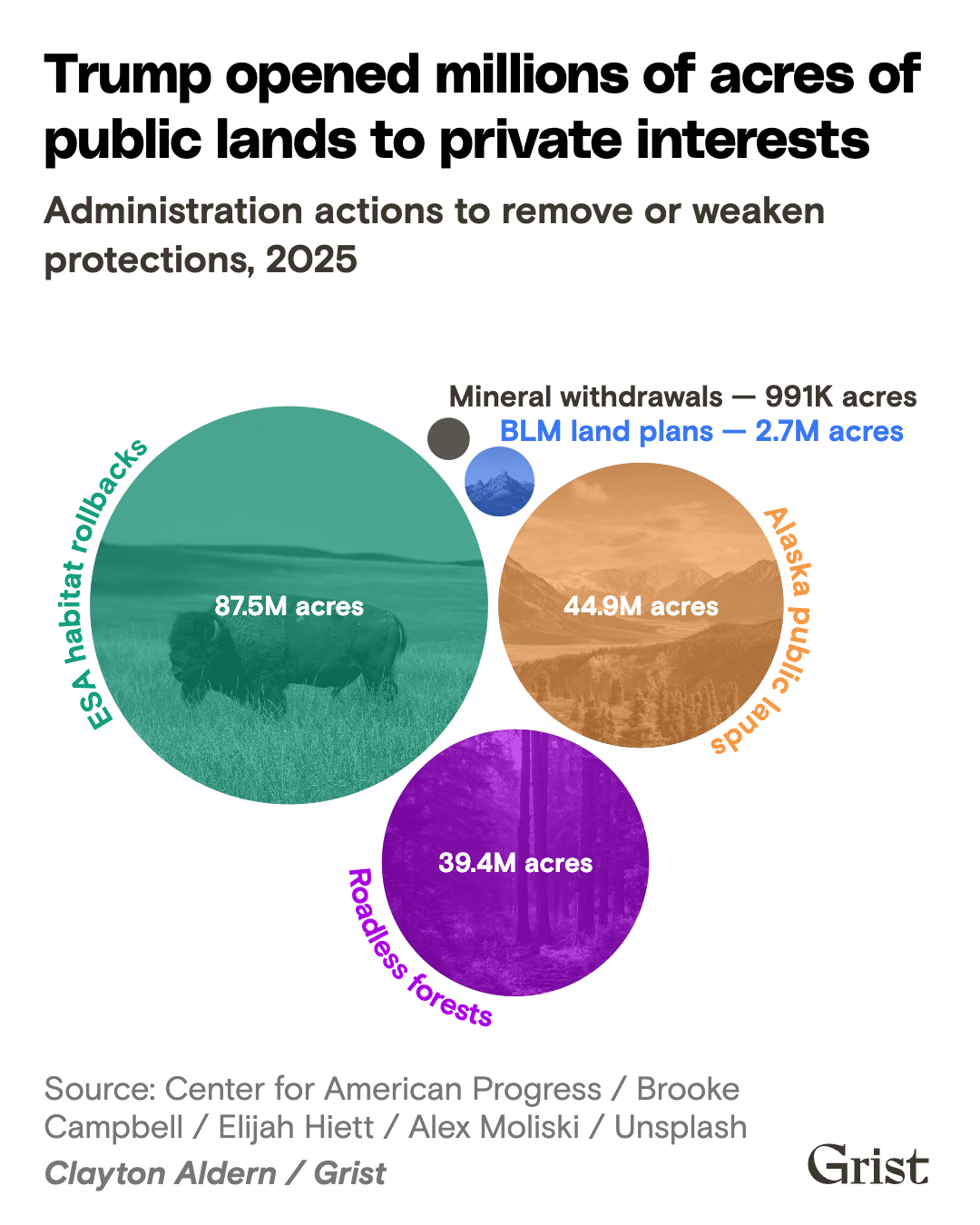
Delivering on his campaign promise to “drill, baby, drill,” President Trump, during his inaugural address, signaled a sweeping overhaul of federal land management. Later that day, he declared a national energy emergency and promised to fast-track domestic energy production and infrastructure “from coast to coast.” The directive marked a profound shift in the management of public land and coastal waters, with the goal of rapidly expanding fossil fuel development.
In the year since, the Trump administration has targeted roughly 88 million acres that were once set aside for recreation and conservation, opening them for oil and gas development and logging. At the same time, the Bureau of Land Management, responsible for managing public lands for multiple uses and long-term sustainability, has held 22 lease sales and approved 6,027 new oil and gas permits, the highest number since 2010, according to the Center for American Progress.
Some of the nation’s most sensitive landscapes are now at risk of development. The administration has, for example, moved to end protections for Arctic National Wildlife Refuge in Alaska, which covers 19 million acres. Other threatened areas include forestland in the Boundary Waters region of Minnesota, the high desert mesas and canyons surrounding New Mexico’s Chaco Culture National Historical Park, approximately 58 million acres of roadless wilderness throughout the national forest system, and roughly 87 million acres of unique habitat for threatened and endangered species. These moves put ecosystems, wildlife, cultural sites, and communities at risk, transforming land once preserved for the public good into resources to be exploited by industry.
– Juanpablo Ramirez-Franco, Midwest regional climate reporter
$1.25 billion in programs terminated or rescinded in 2025
The Inflation Reduction Act set aside about $2 billion to underwrite clean energy and climate resilience projects for tribal nations. The Trump administration has slashed funding for such work, leaving communities scrambling for alternatives and undermining progress toward their energy sovereignty.
The federal grants and incentives helped tribes build solar farms, develop microgrids, expand battery storage, and advance climate-adaptation projects on their lands. For many communities, these initiatives weren’t just about clean energy, but providing a service people elsewhere take for granted. Tribal households face 6.5 times more outages than the U.S. average and a 28 percent higher energy burden. Roughly 54,000 residents of tribal lands lack electricity entirely.
Over the past year, the Trump administration has slashed or frozen programs, including a $20 million grant to an Alaska village fighting coastal erosion, and, among other actions, threatened the Environmental and Climate Justice Block Grant program that had promised $3 billion to 350 recipients. Without that backing, projects have stalled or teetered on collapse, leaving communities scrambling for private funding, philanthropic support, or loans to keep them moving forward.
These cuts do more than slow the clean energy transition. They threaten Indigenous sovereignty, economic opportunity, and resilience to climate change. Tribal nations are having to reconsider their plans, seek new financing, and defend projects that were years in the making. As Washington pulls back, they are pushing forward, but the stakes for their communities, their lands, and their self-determination could not be higher.
— Miacel Spotted Elk, Indigenous Affairs fellow
Percent change in U.S. monthly export volume to China vs. 2024 average
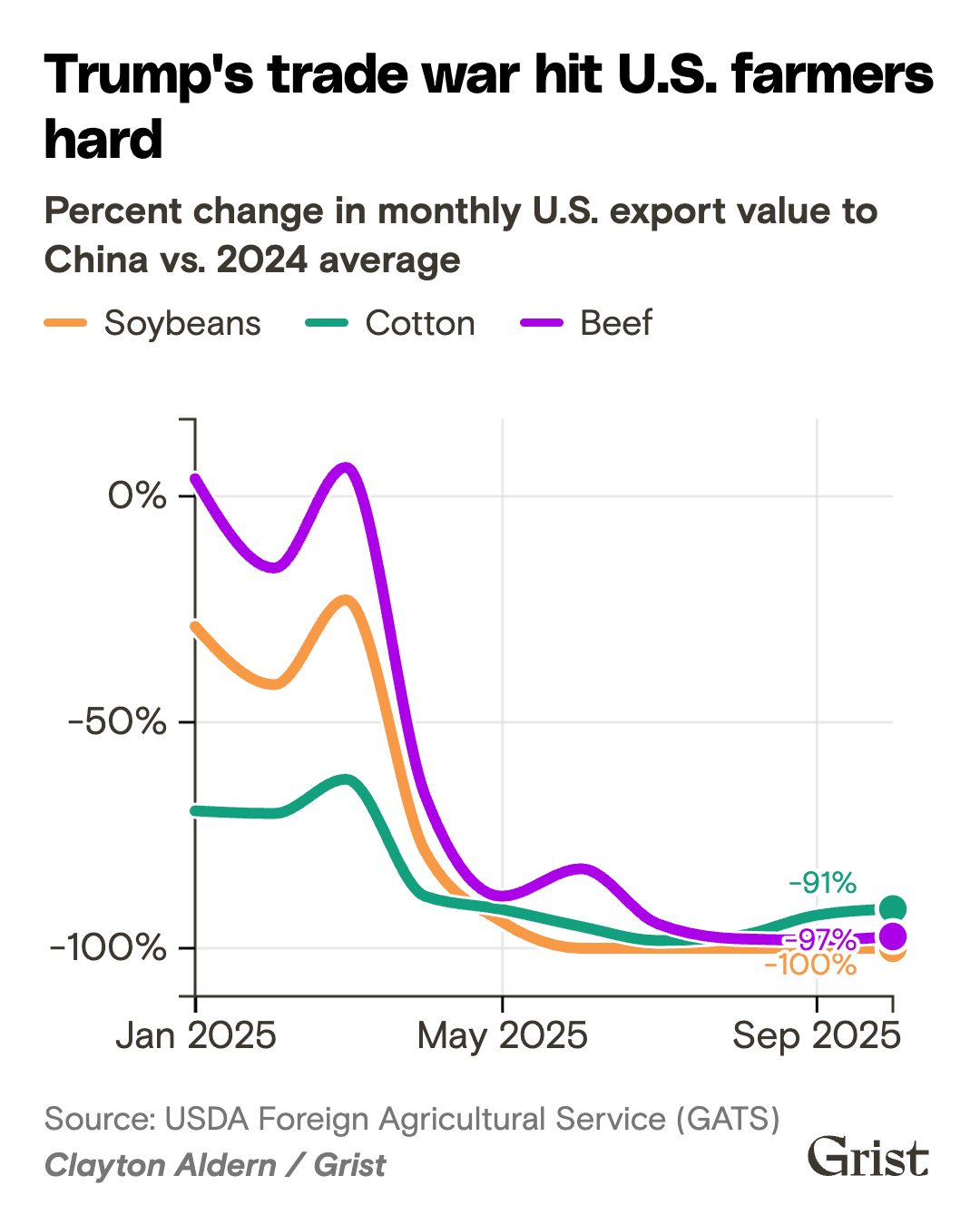
For the nation’s farmers, 2025 was defined by uncertainty and mounting expenses as President Trump’s trade war reshaped agricultural markets. A protectionist agenda that his administration said would protect workers and lower costs instead left growers — particularly those who raise commodities like soybeans — with fewer buyers, higher bills, and an uncertain labor market.
In February, Trump announced 10 percent tariffs on all goods from China, along with 25 percent levies on most imports from Canada and Mexico. Further duties followed in April. China retaliated with a 34 percent tax on products from the United States; in May, it stopped buying U.S. soybeans altogether. The escalating trade war with one of the country’s biggest markets for agricultural exports hit soybean and other commodity farmers hard. It didn’t help that Trump’s tariffs on imported steel and aluminum led to higher prices for farm equipment.
China resumed purchasing U.S. soybeans in October, shortly before Trump announced the two countries had reached a trade deal. But prior to that, the Asian superpower had turned to other soybean producers, including Brazil and Argentina. That move has grave environmental implications. Production of the legume is a major contributor to deforestation in the Amazon and the Cerrado, a biodiverse savannah in central Brazil. Last month, Trump announced $12 billion in bridge payments to help farmers recover from the financial losses they’ve incurred. However, U.S. agricultural trade groups say it doesn’t go far enough to compensate farmers and reassure them that their livelihoods won’t rocked by future trade scuffles.
— Frida Garza, staff writer
Source link
Grist staff grist.org
