Heading into President Donald Trump’s second term, coal looked like an industry nearing the end of its life. Utilities planned to retire more than half of the nation’s coal-fired power plants by 2028, no new facilities were coming online, and production had been flat for years.
Trump’s first year back in office has given the industry an opportunity to retrench. The president is an avowed supporter of coal, and his Department of Energy has repeatedly intervened to prevent plants from shutting down. At the same time, a Trump-supported boom in the construction of artificial intelligence data centers has led to a surging need for power, prompting many utilities to postpone coal facility closures.
The combination of federal intervention and rising energy demand may have stalled coal’s decline, at least for the moment. Consumption increased 13 percent last year, reversing a long downward slide and causing a bump in domestic carbon emissions. Of the 11 coal-fired plants slated for retirement last year, just two shuttered. But one of them may return: A Utah facility closed in November after losing its primary customer, but the Legislature hopes to save it by finding another buyer. Many of the utilities that committed to shutdowns over the next two years have abandoned those plans.
The administration has combined this effort to prop up coal with delays and rollbacks of rules governing pollution and miner safety, actions central to its heavily pro-coal agenda of “Unleashing American Energy.”
Still, these efforts may not reverse a decline that started nearly 20 years ago. The nation’s aging coal plants — more than 200 in all — are increasingly expensive to run, even as methane, more commonly known as natural gas, and solar become cheaper and more abundant. And although the Trump administration has promised to boost employment, layoffs have continued amid the industry’s ongoing contraction.
Coal may see a short-term reprieve, but experts see little hope of a lasting revival. “When you have to get the government to step in to put its thumb on the scale in order to help your industry,” said Sean Feaster of the Institute for Energy Economics and Financial Analysis, “it’s a sign that you’re not particularly competitive, right?”
Chris Wright, a former fracking executive, has played a central role in this revival by turning the Department of Energy into an industry lifeline. He has issued emergency orders delaying the retirement of at least five of the 11 plants slated for closure, and has renewed them every 90 days. That has sparked legal challenges, drawn scrutiny from regulators, and could saddle utilities and ratepayers with millions in added costs.
Wright argues that keeping them open is necessary to avoid blackouts and price spikes. Few beyond his agency are convinced. Environmental groups, energy experts, and state regulators have accused the department of misrepresenting data in its emergency claims.
“It’s just not justified,” said Michael Goggin, an analyst with Grid Strategies. “They’re grasping at what they can.” He has studied the impact of the emergency orders on behalf of Earthjustice and other groups suing to contest the delay order Wright issued in May for the J.H. Campbell coal power plant in Michigan.
Goggin warns the orders could impose significant costs on utilities. He estimates that keeping all of the various fossil fuel plants slated for retirement through 2028 open could cost ratepayers as much as $6 billion — on top of a $6 billion increase in coal-fired generation costs from 2021 to 2024. He calls the extra expense an involuntary subsidy paid by ratepayers to utilities that neither needed nor requested them.
“You’re making [the utilities] keep these plants that most likely they’re not going to need, and are very likely a waste of money,” he said. While plants like Campbell still generate a positive return from selling power, high maintenance costs make them unprofitable. That’s why many utilities have replaced them with methane or renewables.
Under the DOE orders, plant operators can seek approval from the Federal Energy Regulatory Commission to recover these costs from customers. Campbell’s owner, for instance, will spread the expense across millions of ratepayers in the Midwest. Other utilities, however, may struggle. A representative of Colorado’s Tri-State Generation and Transmission Association, a rural co-op, said the organization has no idea how it will pay the expenses associated with a federal order to keep its coal plant in northwest Colorado running.
“We have no information available yet on cost recovery,” the representative said. “At this time, there is not a clear path for doing so.”
The Department of Energy did not respond to requests for comment.
Jim West / UCG / Universal Images Group via Getty Images
Other utilities are postponing closures to meet projected demand from AI data centers. There have been at least half a dozen such delays by investor-owned utilities in the Southeast. The largest of them in Virginia, South Carolina, Georgia, and Mississippi have retooled their investment plans over the last two years, pushing planned retirements into the 2030s.
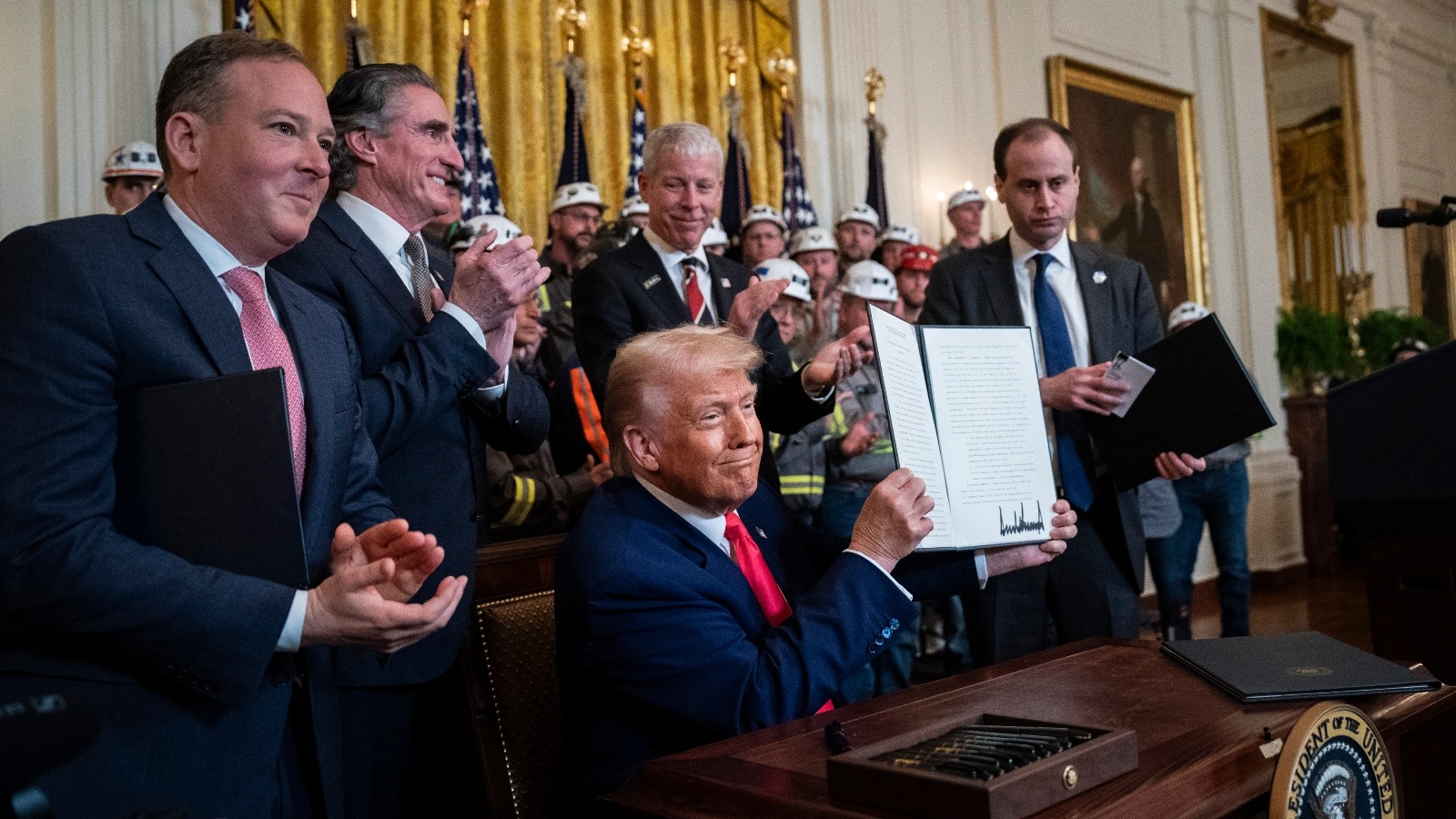
Trump and Wright have endorsed this trend, arguing that coal should play a key role in powering these energy-hungry facilities. In an April executive order intended to revitalize the industry, Trump declared, “Our Nation’s beautiful clean coal resources will be critical to meeting the rise in electricity demand due to the resurgence of domestic manufacturing and the construction of artificial intelligence data processing centers.”
The situation is most extreme in Virginia, which is home to more than 600 of these operations and handles 70 percent of the world’s internet traffic. Experts believe the surge in power demand will force Dominion Energy to import more energy from fossil fuel plants beyond the state, extending the life of polluting facilities in Ohio and West Virginia.
“That region is pretty constrained in terms of supply, so that additional electricity is coming from … additional coal-fired electricity,” said Joe DeCarolis, former head of the Energy Information Administration and now a professor of engineering and public policy at Carnegie Mellon University. According to his analysis, “there’s 25 gigawatts of this aging and costly coal capacity that [will continue] to operate to meet the incremental demand that’s coming from data centers” through 2030.
In South Carolina, for instance, the utility Santee Cooper said it would need to push the closure of its Winyah Generation Plant in Georgetown from 2028 to the mid-2030s so it can meet demand from data center development. The plant has received numerous state citations for violating air emissions of sulfur dioxide and has been criticized for operating with expired wastewater discharge permits.
“I think they’re responding to market conditions and political atmosphere, and the political atmosphere is creating the market conditions,” said Marilyn Hemingway, the head of the Gullah Geechee Chamber of Commerce, who lives in Georgetown a few miles from the plant.
Hemingway is a member of a state-mandated transition council overseeing the shutdown of Winyah and Santee Cooper’s other coal assets. She said the utility has repeatedly delayed closing the plant and has yet to decide what energy source will replace coal.
“I’m not naive about this at all,” she said. “I know you have to replace it, but I find it problematic because it’s dragging this transition out.”
Living near coal plants like these may become more dangerous because of Trump’s interventions. Even as the Department of Energy has moved to keep such operations open, the Environmental Protection Agency has rolled back a suite of rules governing their air and water pollution. Over the past year, the agency repealed limits on mercury and other toxic pollutants, scrapped greenhouse gas limits, and extended deadlines allowing coal plants to dump waste, called coal ash, in unlined pits — a move that spared 11 facilities from imminent shutdown. Meanwhile, the Department of the Interior opened 13 million acres of public land for mining.
Emily Arthen, CEO of the American Coal Council, said such regulations were onerous, unnecessary, and contributed to coal’s decline. “Doing the right thing without having to be told is forefront for the industry,” she said, adding that minimal oversight allows the industry to preserve jobs.
Some miners and their families feel the sector hasn’t taken much initiative with regard to worker safety. They are particularly frustrated by the administration’s inaction on a regulation limiting exposure to silica dust, a carcinogen that causes a chronic, fatal condition called silicosis but known more commonly as black lung disease. The rule, finalized during the Biden administration after decades of advocacy, remains stuck in limbo even as the number of cases of the terminal condition skyrockets among young miners.
Vonda Robinson, vice president of the National Black Lung Association, said her only option is to keep fighting. She and her husband John Robinson, a retired coal miner, feel betrayed by an administration whose coal production goals they initially supported. Over the past year threats to mine safety offices and layoffs at the federal agency that runs black lung screenings disrupted protections for miners. Vonda Robinson even wrote to Vice President J.D. Vance, urging him to confront the epidemic. She never received a response.
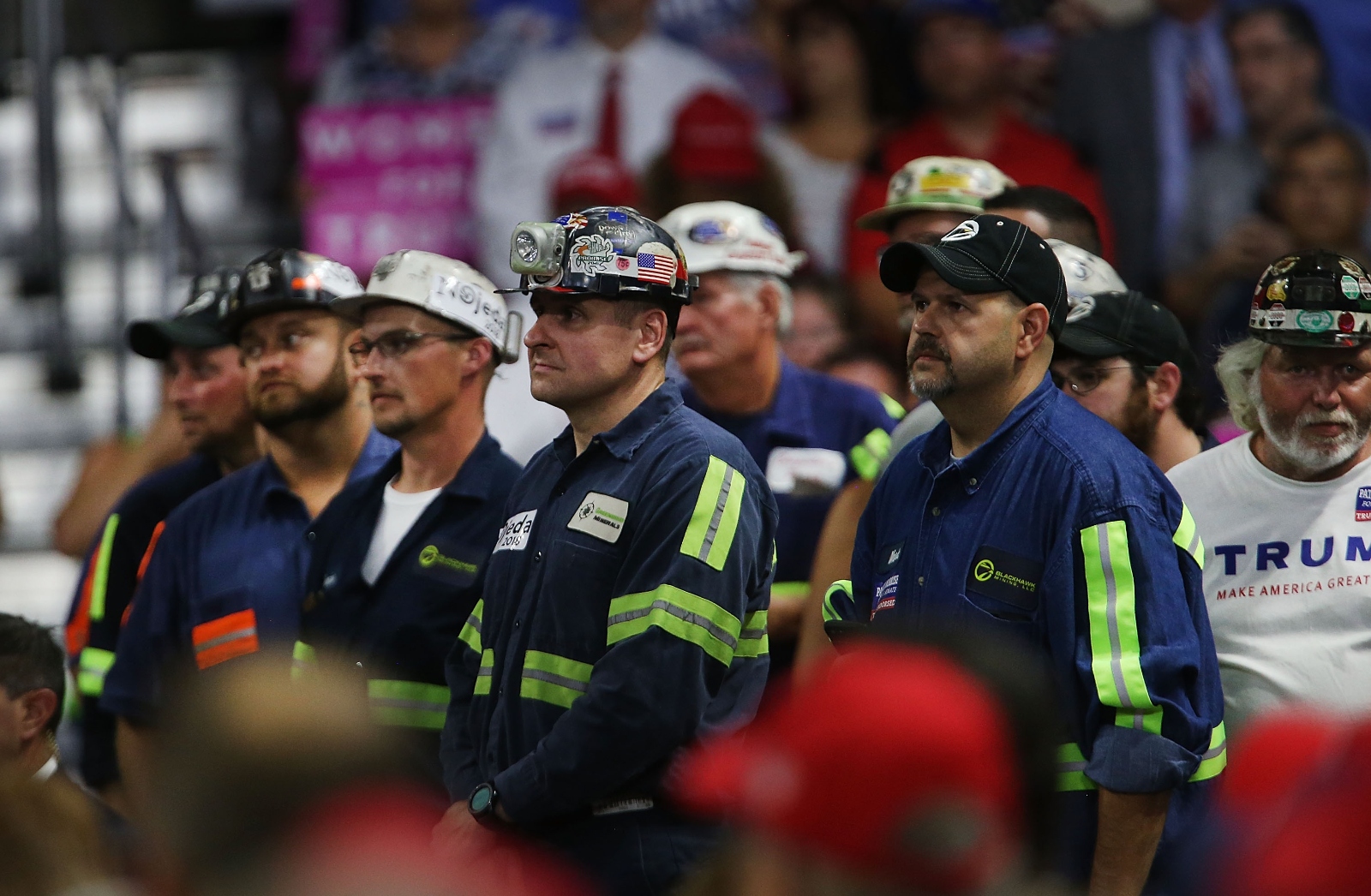
Photo by Spencer Platt / Getty Images
“If we don’t take care of those miners that’s in there now, we’re not gonna have coal, we’re not gonna have a coal industry,” Robinson said. Her husband, who is awaiting evaluation for a double lung transplant, said he felt abandoned by the industry that fed his family.
“The coal miner’s your workhorse,” he said of the industry’s attitude toward men like him. “When you fall over dead, we’re gonna get another horse.”
Efforts to spur new coal extraction, meanwhile, are faltering. When the Interior Department opened public lands to mining, bids came in below market rate, and three projects in the West collapsed within a month. With no new coal-fired plants planned, the market for thermal coal they burn — much of it mined in the West — remains bleak. So does the market for metallurgical coal, used to make steel, which comprises most coal mined in the Eastern U.S.
Coal mining employment held relatively steady in 2025; the mining workforce stands at around 40,000 workers, less than a quarter of its size in the 1980s. But Erin Bates, communications director for the United Mine Workers of America, warned of trouble ahead. China has stopped importing metallurgical coal used to make steel, undercutting demand for ore mined largely in Appalachia. Overall coal exports fell 14 percent between January and September 2025, and international demand is expected to plateau in the coming years as renewable energy continues to expand; coal power generation fell in both China and India last year after rising for decades.
“It’s something that will trickle down,” Bates said. “The end result is, if they can’t export this coal, and the cost of coal plummets because no one’s buying it, that’s going to mean layoffs, that’s going to mean shutdowns.”
Though one stated goal of Trump’s “Unleashing American Energy” agenda is to “create jobs and prosperity” in extraction and energy production, Harvard labor economist Gordon Hanson doubts the administration’s moves will deliver. What’s actually being built, he said, are gas plants, along with wind and solar projects approved under, and funded through, the Biden administration. Renewable energy generated more electricity than coal power for the first time last year, and Hanson said any effort to revive coal rely less on economics than on nostalgia.
“Many Trump administration policies seem more symbolic than realistic,” Hanson said.
Source link
Katie Myers grist.org