
Over the last few years, conversations about the weather have started to change. Storms feel more intense. Rainfalls feel excessive. Outages that once felt rare now seem routine. At the same time, utility costs across much of the country are climbing quickly, often year after year, with little explanation and fewer options for homeowners who are already feeling stretched.
These trends are connected. Storms have become the most common disruptor of the national electric grid, while the cost of maintaining an aging infrastructure is increasingly passed on to customers. Power outages are lasting longer and people are paying more for a system that feels less reliable than it used to be. As conditions grow more extreme and demand continues to rise, utilities are spending enormous sums just to keep their systems operating.
Grid reliability has quietly turned into the most serious infrastructure problem we are dealing with. Energy is still being pushed through an ageing system that’s now under more stress and variability than it was ever designed to handle. For homeowners, that reality shows up in two very practical ways – higher costs and increased power outages.
Grid Reliability Under Stress
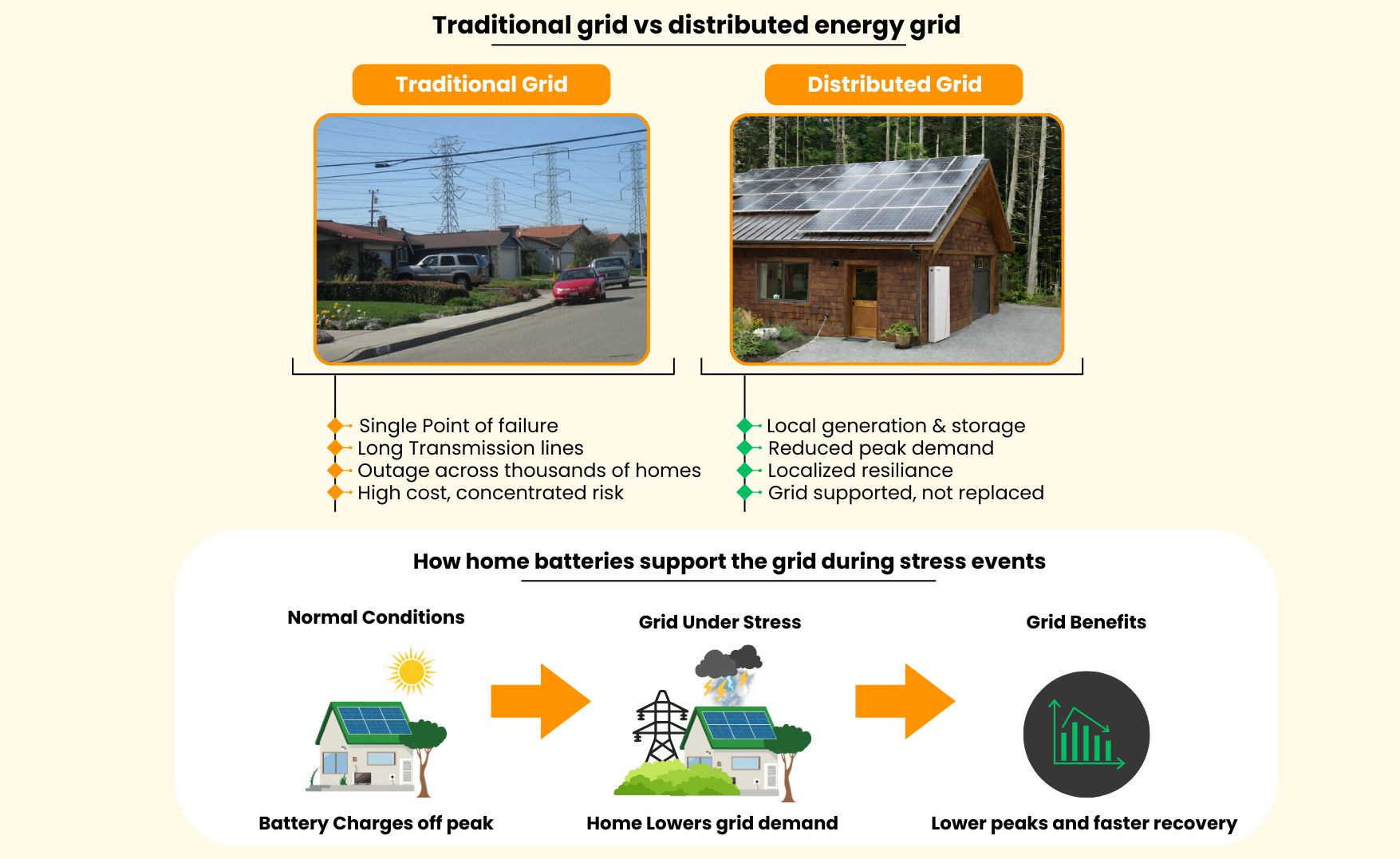
The electric grid was built for a different era when power was generated at large, centralized plants and delivered over long distances to homes and businesses. For many years, that approach worked well enough. Long transmission lines create vulnerability by design. A single damaged line or failed transformer can leave thousands of customers without power. As storms grow more intense and less predictable, utilities need to maintain infrastructure that was never meant to operate under this level of stress. A growing share of investment now goes into emergency repairs and reactive upgrades, not into long-term resilience.
At the same time, electric demand keeps rising. Electrification is accelerating. Energy use continues to climb. New loads like electric vehicles, data centers and artificial intelligence, are pulling enormous amounts of power through centralized systems that are already stretched thin. Utilities are expected to deliver near-perfect reliability, meet decarbonization goals, manage workforce shortages, and operate under constant public scrutiny, all while maintaining their infrastructure that requires continuous attention. The cost of all of this ultimately flows back to customers, contributing to the rising utility rates.
Distributed Energy Changes the Equation

Instead of relying entirely on distant power plants, energy can be generated and stored closer to where it is actually used. Homes with solar and battery systems store energy when supply is available and reduce demand during peak periods. In doing so, they absorb variability that would otherwise stress the grid. For homeowners, this can mean lower and more predictable energy costs over time, along with protection from outages. For utilities, it means reduced peak demand and improved stability during extreme conditions.
Distributed energy ensures grid reliability by turning it from a one-way delivery model into something more flexible. Energy can flow in both the directions. When parts of the grid are compromised, local systems can continue operating, keeping critical loads online and reducing the severity of outages.
Why Home Batteries Matter Beyond the Home

Residential battery systems are often framed as personal backup solutions, and that benefit is real. Stored energy can keep essential systems running without fuel deliveries, noise, or emissions. But the broader impact matters just as much. When large numbers of homes reduce demand at the same time, overall strain on the grid decreases. Outage recovery becomes faster. Emergency generation is used less frequently. During high-stress events, that also means cleaner air and quieter neighborhoods.
In this way, residential storage becomes part of the grid’s reliability strategy, even though it is owned and operated at the household level. It helps utilities manage peaks and disruptions while giving homeowners more control over both reliability and cost.
Energy Planning and Policy Are Catching Up
Energy planning is beginning to reflect the reality utilities are facing, even if it’s happening slowly. Some utilities and state agencies are now factoring in distributed energy into long-term grid reliability planning rather than treating it as a niche case. Programs like virtual power plants, demand response, and updated incentive structures are early signs that the system is adapting, even if unevenly.
Policy is moving in the same direction. Several states have begun passing legislations that encourage homeowners to add battery storage, not just for personal backup, but also to help grid health. In the US, California has led the way with strong battery incentives tied to grid reliability and wildfire mitigation. Other states are following with their own approaches. Washington State, for example, is actively working through changes related to battery incentives and time-of-use rate structures, which increasingly reward households that can shift or reduce demand during peak periods.
These policy shifts aren’t about forcing a new technology on the system. They’re a recognition that the old model can’t simply be scaled up to meet modern conditions. Distributed energy offers a practical way to reduce strain, manage peaks, and improve resilience without waiting decades for system-wide rebuilds.
The transition isn’t fast, and it isn’t perfectly coordinated. But the direction is clear. Planning and policy are starting to align with how energy is being used, and homeowners are becoming part of the grid reliability solution rather than just end users at the end of the line.
Reliability Comes from Many Small Supports
The future of grid reliability will not be secured by a single breakthrough or by building ever-larger power plants. It will come from distributing risk, adding flexibility, and allowing energy to move in more than one direction. Distributed energy does not replace the grid; it strengthens it. By reducing peak demand, localizing resilience, and easing the strain on aging infrastructure, it offers a path that aligns with today’s risks and realities.
A Homeowner’s Perspective
For homeowners, this discussion is paramount in their energy planning. Outages disrupt daily life. Utility bills feel less predictable every year. Waiting decades for large-scale infrastructure upgrades offers little comfort when the next storm arrives or when rates rise again.
Distributed energy gives homeowners a practical role in grid reliability. Solar power paired with battery storage provides control, stability, and protection without waiting for system-wide fixes. It allows households to manage rising energy costs, maintain power during outages, and contribute to a grid that is less brittle overall.
The grid of the future will depend on decisions made both at the center and at the edges. What happens in individual homes matters more than it once did. Reliability improves not just through scale, but through design, flexibility, and shared responsibility.
Source link
ecoideaz ecoideaz.com
