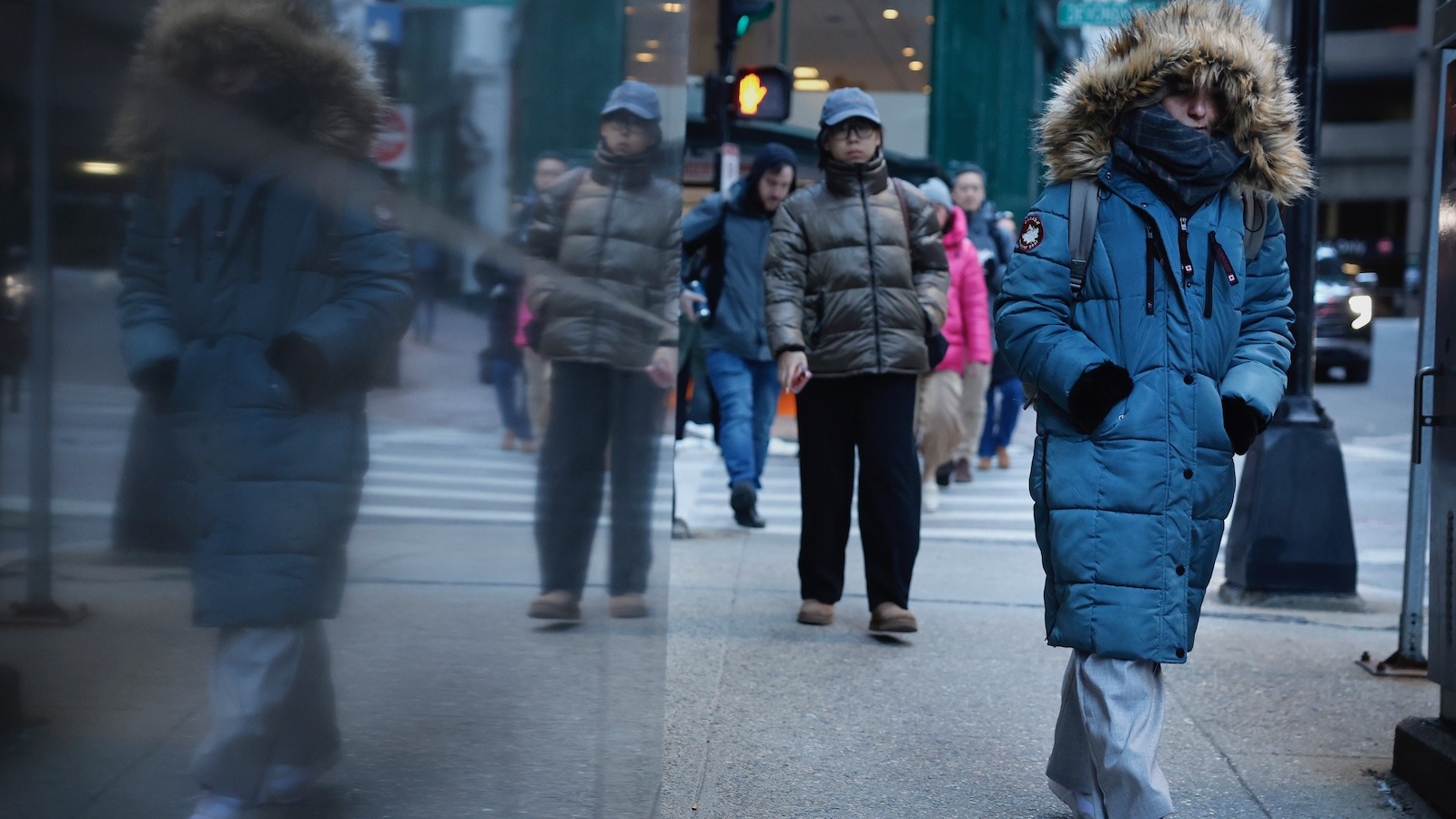
A massive, frigid storm is developing across the United States, stretching from the Southwest up into the Northeast and putting much of the country in a deep freeze until early next week. The Weather Channel warns that more than 230 million people — two-thirds of the country’s population — could be impacted by the system, which is producing heavy snow and “catastrophic” ice accumulations. The Northern Plains could experience wind chills below -50 degrees Fahrenheit, according to the National Weather Service. It’s also warning of widespread disruptions to travel and power, which will make things even more dangerous for people who can’t heat their homes.
If it feels like you’re at the North Pole right now, it’s because you kind of are. Swirling high above the Arctic is a very cold air mass known as the polar vortex. This is encircled, and typically trapped, by a strong wind pattern called a jet stream, which is at a lower level in the atmosphere. That separates cold air in the Arctic from warmer air to the south.
Things are changing up north, though, as it warms four times faster than the rest of the planet, a phenomenon known as Arctic amplification. Dwindling sea ice exposes darker waters, which absorb more of the sun’s energy than ice does. Warming in the region, then, leads to more warming, and on and on. Indeed, Arctic sea ice has been reaching record low extents. So these days, there’s less of a temperature contrast between the Arctic and warmer regions to the south than before. “When that happens, the jet stream tends to meander a lot, and that allows very cold air to come down to the south,” said Ayumi Fujisaki-Manome, an earth scientist at the University of Michigan.
Research suggests that the jet stream has been weakening of late, making it wobblier. That could increase the likelihood of weather like we’re experiencing now, though this remains a matter of active research within the scientific community. “The problem is that it’s really hard to show whether or not that’s happening,” said Jacob Chalif, who studies the phenomenon at Dartmouth College. “Arctic amplification started really kicking off in the ’90s, and we only have really solid records of the jet stream going back to 1979.”
That leaves researchers with only about a decade to use as a baseline, Chalif added, while in an ideal world they’d have many more years to determine trends. So last year, Chalif led a study that used machine learning to analyze climate records stretching back to 1901. The team found that before 1979, there were plenty of years when the jet stream got wavy, and it was at times even more pronounced than today. “In other words, the impact of climate change on the jet stream, I think, remains unclear,” Chalif said. “I don’t think we have a smoking gun that we’re making the jet stream wavier yet.”
Still, climate change is supercharging these kinds of storms in general. The research group Climate Central notes that right now the waters of the Gulf of Mexico and the Pacific off Baja California are exceptionally warm, and that’s been made much more likely because of humanity’s carbon emissions. This loads the atmosphere with extra moisture, which collides with the system swooping down from the Arctic to supercharge the storm. In addition, the warmer the atmosphere gets, the more moisture it can hold, and the more precipitation can dump out of extreme weather events.
So when President Donald Trump sees this polar vortex unfolding and asks in a post on X, “WHATEVER HAPPENED TO GLOBAL WARMING???,” the answer is that climate change is very much a driver of the brutal conditions that 230 million Americans could experience in the days ahead. “Judging climate change by a cold storm is like judging a baseball season by a single inning,” said Kaitlyn Trudeau, a senior research associate for climate science at Climate Central, in a statement. “But, climate change has a tangible impact on this storm.“
Source link
Matt Simon grist.org